

Joint custody in India is an idea many separated parents consider, but few actually achieve. For most families, the reality is stark: courts typically award sole custody to one parent, with the other granted visitation rights. This leaves many children seeing one parent only on weekends or holidays. The reasons for this are complex, rooted not just in law but also in deep-seated cultural expectations and practical challenges.
Understanding why joint custody remains rare matters to anyone facing a family breakup, whether as a parent, lawyer, or concerned relative. The issue goes beyond the courtroom, touching on social stigma, gender roles, and what is genuinely best for the child. As more families question traditional norms and push for shared parenting, the need for clarity grows. This article explains the barriers to joint custody in India, the legal hurdles, and the cultural forces at play.
Joint custody in India is uncommon because of a combination of legal ambiguities, traditional family expectations, and concerns about parental cooperation and the child’s welfare. Courts usually favour sole custody, citing stability and the child’s best interests, unless both parents demonstrate exceptional cooperation and minimal conflict.
Why Joint Custody Remains Rare in Indian Family Law
Key takeaways
– Joint custody is rarely granted by Indian courts; sole custody with visitation is the norm.
– Cultural expectations around gender and parenting heavily influence custody outcomes.
– Indian statutes do not explicitly define or mandate joint custody, making it a discretionary remedy.
– Courts prioritise the ‘best interests of the child’, often equating this with stability over shared parenting.
– Social stigma and lack of parental cooperation are major practical barriers.
– Recent Law Commission reports and court judgments have called for reforms, but implementation is slow.
– Shared parenting requires high trust and communication, which is often missing after separation.
– The legal process is lengthy, expensive, and emotionally taxing for families seeking joint arrangements.
– Awareness and acceptance of joint custody is growing, but progress is gradual.
– Each custody case is decided on its unique facts and family circumstances.
What Is Joint Custody and How Does It Work in India?
Joint custody means both parents share legal responsibility and decision-making for a child after separation or divorce. In India, joint custody is not directly defined in any family law statute, but courts may grant it under their broad powers to act in the child’s best interest. Unlike sole custody, where one parent is the primary caregiver, joint custody aims for both parents to remain actively involved in the child’s upbringing.

Legal Definition and Variants
Indian law recognises different types of custody, though not always by those names. There are two main forms:
- Physical custody: Where the child lives and who manages daily care.
- Legal custody: Who makes major decisions about the child’s education, health, and welfare.
Joint custody can mean both parents share physical custody (the child splits time between homes), legal custody (shared decision-making), or both. Most commonly, courts award sole physical custody to one parent and allow the other visitation, calling this ‘custody with visitation rights’. True joint physical custody, where the child spends roughly equal time with each parent, is rare.
How Courts Decide Custody
The court’s main consideration is the ‘best interests of the child’. This principle is found across Indian laws like the Guardian and Wards Act, 1890 and the Hindu Minority and Guardianship Act, 1956. Factors include the child’s age, health, emotional bonds, schooling, and sometimes the child’s own wishes if old enough. Courts may appoint a guardian ad litem (a representative for the child’s interests) in complex cases.
Joint Custody in Practice: An Illustration
Suppose A and B separate and both seek custody of their 10-year-old daughter. If the court finds both parents capable, lives nearby, and can cooperate, it may order joint legal custody, with the child living mainly with one parent but regular overnight stays with the other. The court may specify a schedule: alternate weekends, half of school holidays, or even split weeks. But if A and B cannot communicate civilly, the court is unlikely to impose joint custody.
For a detailed overview of custody arrangements, see Child Custody Laws in India: Legal Realities, Challenges, and Strategic Insights.
Why Do Indian Courts Rarely Grant Joint Custody?
Indian courts rarely grant joint custody because they perceive it as potentially destabilising for the child, especially in high-conflict family environments. The lack of statutory guidance and the practical difficulty of enforcing shared parenting orders also discourage courts from choosing this path.
The Legal Landscape: Statutory Gaps and Judicial Discretion
No Indian family law – whether the Hindu Minority and Guardianship Act, the Guardian and Wards Act, or the Special Marriage Act – explicitly mandates or even defines joint custody. Instead, courts interpret the ‘welfare of the child’ flexibly. This leads to wide discretion, with most judges preferring a single stable home over a complex arrangement.
The Law Commission of India in its 257th Report (2015) recommended amending the Guardian and Wards Act to explicitly allow joint custody and shared parenting, but these recommendations have not yet become law (PRS Legislative Research).
Key Reasons Courts Avoid Joint Custody
The main reasons include:
- Stability: Judges believe a single home environment is less disruptive for the child.
- Parental Conflict: Most separating couples have significant mistrust or hostility, making cooperation difficult.
- Enforcement Issues: Indian courts lack mechanisms to enforce detailed parenting plans.
- Practical Barriers: Long travel distances, differing school and activity schedules, and extended family pressures complicate joint arrangements.
In high-conflict cases, courts worry that joint custody becomes a battleground, with the child caught in the middle. Even where both parents are loving, if they cannot communicate effectively, judges are reluctant to risk the child’s well-being.
Judicial Attitudes and Precedents
While some courts have experimented with joint custody (for instance, Gaurav Nagpal v. Sumedha Nagpal (Supreme Court, 2008)), the default remains sole custody. The Supreme Court has repeatedly held that the child’s welfare trumps parental rights, and practical considerations often outweigh ideals.
How Cultural Barriers Shape Custody Outcomes in India
Cultural attitudes in India play a significant role in why joint custody is rare. Parenting is still viewed through a traditional lens, with mothers seen as primary caregivers and fathers as providers. This shapes both family expectations and court decisions.
Gender Stereotypes and Family Roles
Most Indian families expect mothers to raise children after separation, especially younger ones. Fathers are often seen as less involved in daily care. While the law is gender-neutral, these social norms influence judges, lawyers, and even the parties themselves. For example, the Hindu Minority and Guardianship Act gives the father the status of ‘natural guardian’, but the ‘custody’ of young children is usually given to the mother, reflecting practical caregiving.
The Role of Extended Family
In many Indian households, grandparents, uncles, and aunts are deeply involved in child-rearing. After divorce, these extended family members may pressure for sole custody to maintain continuity in the child’s life. Joint custody is often seen as disruptive or even shameful, especially in conservative communities.
Social Stigma Around Divorce and Shared Parenting
Divorce itself carries stigma in many parts of India. Joint custody arrangements, which require ongoing cooperation between ex-spouses, are often viewed with suspicion. Some families fear that shared parenting will confuse the child or destabilise their sense of home. These attitudes make parents less likely to request joint custody, and judges more hesitant to grant it.
Impact on Children
Children in joint custody arrangements may face questions or teasing from peers and relatives. They may also struggle to adjust to two households, different rules, and the social perception of a ‘broken’ family. These practical realities weigh heavily on both parents and courts.
Legal Hurdles and Practical Challenges to Joint Custody in India
The legal system in India presents several obstacles to joint custody. Courts must balance the law, the child’s best interests, and practical realities – often erring on the side of caution.
Statutory Framework and Judicial Discretion
Unlike some countries, India does not have a unified family code or a clear statutory definition of joint custody. The Guardian and Wards Act, 1890, and personal laws (like the Hindu or Muslim laws) give judges wide discretion. While this allows for flexibility, it also leads to uncertainty. Parents seeking joint custody must convince the court that their arrangement will not harm the child.
Process for Seeking Joint Custody
Seeking joint custody usually involves the following steps:
- Filing a petition: Either parent may apply for custody in the appropriate family court.
- Submission of evidence: Both parents submit affidavits, evidence of their parenting abilities, and proposals for the child’s care.
- Court-ordered mediation: Many courts direct parents to attempt mediation to reach an agreement.
- Interim orders: The court may grant temporary custody or visitation while the case proceeds.
- Final hearing: The judge considers all evidence, the child’s wishes (if appropriate), and expert reports before issuing an order.
The process can take months or even years, especially if the parents disagree. Costs include court fees, lawyer charges, and sometimes expenses for expert reports or counselling.
Enforcement and Modification
Even if joint custody is granted, enforcement is difficult. Courts lack the resources to monitor compliance. If one parent violates the order, the other must return to court for enforcement, which is time-consuming and stressful. Orders can be modified if circumstances change, but this requires a new application and fresh evidence.
For examples of how custody battles play out see When Custody Battles Get Messy: Real-World Courtroom Tactics in India.
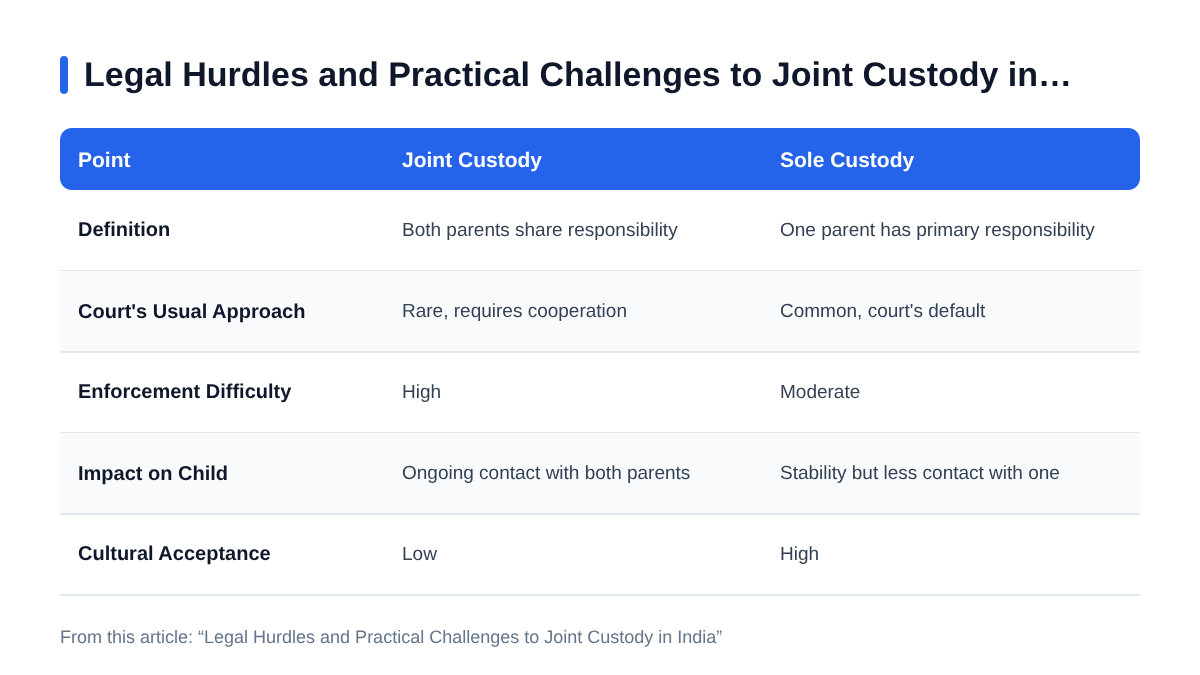
Comparison Table: Joint Custody vs Sole Custody in India
| Point | Joint Custody | Sole Custody |
|---|---|---|
| Definition | Both parents share responsibility | One parent has primary responsibility |
| Court’s Usual Approach | Rare, requires cooperation | Common, court’s default |
| Enforcement Difficulty | High | Moderate |
| Impact on Child | Ongoing contact with both parents | Stability but less contact with one |
| Cultural Acceptance | Low | High |
| Legal Clarity | Low, not defined in statutes | High, well established |
Most families find sole custody easier to implement, though some children benefit from continued access to both parents.
The Role of Parental Cooperation and Trust in Shared Parenting
Joint custody relies on a high degree of cooperation and communication between parents. In the absence of trust, shared parenting arrangements often break down, which courts try to avoid.
Why Cooperation Is Essential
Shared parenting requires parents to coordinate schedules, make joint decisions, and resolve disagreements without constant court intervention. This can be challenging, especially when emotions are raw after separation. Without trust and effective communication, the arrangement can expose the child to ongoing conflict.
Common Challenges to Parental Cooperation
- Poor communication: Parents may refuse to speak to each other except through lawyers.
- Interference by relatives: Extended family can complicate discussions and fuel disputes.
- Unresolved grievances: Past marital issues often spill over into parenting discussions.
- Manipulation of the child: Sometimes, one parent tries to turn the child against the other (known as parental alienation).
How Courts Assess Cooperation
Judges look for evidence that parents can put the child’s needs above their own. This may include:
- Prior examples of successful co-parenting (school events, medical decisions, etc.).
- Willingness to compromise and follow court orders.
- Absence of ongoing litigation or police complaints between the parties.
If the court sees ongoing hostility or a lack of maturity, joint custody is unlikely.
Best Practices and Emerging Trends in Joint Custody India
While joint custody is still rare, there are signs of change. Recent court judgments and policy recommendations suggest a gradual shift towards recognising the benefits of shared parenting, provided the child’s welfare remains central.
Recent Developments
- The Law Commission’s 257th Report (2015) advocated for explicit legal provisions on joint custody and parenting plans.
- Some High Courts, notably the Delhi High Court and Bombay High Court, have issued orders encouraging shared parenting in suitable cases.
- Family courts in metropolitan areas are increasingly open to creative solutions, such as alternating weekends, shared holidays, and flexible visitation.
Best Practices for Parents Seeking Joint Custody
If both parents wish to pursue joint custody, the following steps can improve their chances:
- Present a detailed, practical parenting plan addressing living arrangements, schooling, holidays, and conflict resolution.
- Show evidence of cooperation, such as joint attendance at school meetings or medical appointments.
- Agree to mediation or counselling to resolve disputes out of court.
- Focus on the child’s needs, not parental grievances.
International Perspectives
Countries like the United States, United Kingdom, and Australia have clearer statutory frameworks for joint custody and shared parenting. These systems offer lessons for India, such as the importance of detailed parenting plans, court-monitored compliance, and accessible family support services (UK Family Justice System).
The Road Ahead
The trend is slowly moving towards recognising joint custody as a viable option. However, until laws are amended and social attitudes evolve, it will remain the exception rather than the rule.
Frequently Asked Questions
What is joint custody in India?
Joint custody in India refers to an arrangement where both parents share legal and/or physical responsibility for a child after separation. This means both parents remain involved in key decisions and the child’s day-to-day life, though the specifics may vary by court order.
How is joint custody different from sole custody?
In joint custody, both parents share decision-making and may split physical custody, while in sole custody, only one parent has primary responsibility and the other may have visitation rights. Joint custody requires more cooperation between parents.
Is joint custody legally recognised in Indian law?
Indian statutes do not explicitly define or mandate joint custody, but courts can grant it using their discretionary powers under the Guardian and Wards Act, 1890, and the Hindu Minority and Guardianship Act, 1956, based on the child’s best interests.
On what basis do courts decide custody cases?
Courts decide custody based on the ‘best interests of the child’, considering factors such as the child’s age, emotional bonds, parental abilities, schooling, and, where appropriate, the child’s own wishes. The law prioritises the child’s welfare above parental preferences.
What are the main cultural barriers to joint custody in India?
Cultural barriers include traditional gender roles, stigma attached to divorce, family expectations about child-rearing, and reluctance to accept shared parenting. These factors make families and courts hesitant to adopt joint custody.
Can both parents get equal physical custody?
Equal physical custody is rare in India. Courts may order it if both parents live nearby, can cooperate, and the arrangement serves the child’s interests, but usually, one parent is given primary custody with visitation for the other.
What practical challenges exist in implementing joint custody?
Practical challenges include coordinating schedules, travel between homes, differing parenting styles, interference from extended family, and ongoing parental conflict. These make joint custody difficult to sustain.
How can parents improve their chances of getting joint custody?
Parents should present a detailed, workable parenting plan, show evidence of cooperation and communication, agree to mediation or counselling, and focus on the child’s needs above personal grievances.
Are there any recent legal reforms regarding joint custody?
The Law Commission of India recommended reforms in its 257th Report (2015), advocating for explicit provisions on joint custody, but these have not yet become law. Some courts have issued progressive judgments, but statutory reform is pending.
What is a parenting plan in the context of joint custody?
A parenting plan is a detailed document outlining how parents will share responsibilities, time, and decision-making for their child after separation. It covers living arrangements, schooling, holidays, and dispute resolution mechanisms.
How long does a joint custody case take in India?
A joint custody case can take several months to a few years, depending on the complexity, cooperation between parents, and the court’s workload. Interim orders may be issued for temporary arrangements.
What happens if one parent violates a joint custody order?
If a parent violates a joint custody order, the other can apply to the court for enforcement. The court may issue warnings, modify the order, or in persistent cases, change custody arrangements.
Are there any psychological effects of joint custody on children?
Research suggests that, when parents cooperate, joint custody can benefit children by maintaining strong relationships with both parents. However, ongoing conflict or instability can cause stress or confusion for the child.
How common is joint custody in India compared to other countries?
Joint custody is far less common in India than in countries like the United States or United Kingdom, where statutory frameworks and social acceptance are stronger. In India, most cases still result in sole custody with visitation.
Can joint custody be modified later?
Yes, joint custody orders can be modified if circumstances change or if the arrangement is not working in the child’s best interests. Either parent can apply to the court for a change.
The Future of Joint Custody in India: Gradual Change, Ongoing Challenges
Joint custody in India remains the exception rather than the rule, shaped by a mix of legal ambiguities, cultural beliefs, and practical constraints. While courts have the power to order shared parenting, they do so rarely, preferring stability and clear lines of responsibility. The legal framework is slowly evolving, with calls for reform from the Law Commission and some progressive judgments, but widespread change will require shifts in both law and public attitude.
Parents who believe joint custody is best for their child must be prepared to demonstrate cooperation, trust, and a detailed plan. Legal advice and mediation can help, but there are no guarantees. As awareness grows and more families seek alternatives to sole custody, the system may adapt to better reflect the realities of modern Indian families.
This article is general information, not legal advice.