

You walk into the family court in Chandigarh, files in hand, thinking maybe this will be over in a few months. But then the waiting starts: paperwork, court hearings, endless arguments between lawyers, and nothing seems to move. The contested divorce timeline in India is rarely quick, and for most families, it feels like the process is designed to test your patience more than anything else. If you’re stuck in a legal dispute over divorce, you’re not alone – and honestly, no one warns you how drawn-out things can get.
Why does it matter? Divorce isn’t just a personal issue – it’s about kids’ futures, property you worked for, and the chance to start fresh. But between evidence requirements, child custody battles, and property division delays, the whole system can feel stacked against quick resolution. Getting a realistic grip on the contested divorce timeline is the first step to surviving it.
A contested divorce in India often takes anywhere from three years to over seven, with delays common due to evidence gathering, child custody disputes, property division, and repeated court hearings. There’s rarely a shortcut – each complication adds months or even years. Knowing what to expect helps you plan, emotionally and financially.
Why Contested Divorce Takes So Long in India
A contested divorce means both sides don’t agree – on the divorce itself, or on issues like property, custody, or maintenance. This lack of agreement puts the court in the driver’s seat. The process moves slowly because the court must examine every claim, every document, and every accusation before making a decision.
Main reasons for delay:
– Multiple rounds of court hearings for every small issue
– Strict evidence requirements for proving claims (adultery, cruelty, financial matters)
– Child custody battles that involve social worker reports and psychologist input
– Property division delays when assets are disputed or hidden
– Frequent adjournments due to lawyer tactics or judge schedules
Let’s be honest – most people expect the process to be slow, but few realise just how many moving parts are involved. Every court hearing can get pushed if one side’s lawyer is busy. If someone changes their statement, the court has to re-examine everything. Even basic paperwork can go missing, causing weeks of extra waiting.
The Typical Contested Divorce Timeline
While each case is different, the average contested divorce in India follows this pattern:
- Filing of Petition: One spouse files for divorce, stating the grounds (like cruelty, desertion, adultery).
- Service of Notice: The other spouse is formally notified and given time to respond.
- Reply and Counter-Claims: The respondent files their objections and any counter-claims (like for custody or alimony).
- Framing of Issues: Court lists the key points to be decided.
- Evidence Stage: Both sides submit documents and witness statements.
- Cross-Examination: Witnesses are questioned by both lawyers.
- Final Arguments: Both sides present their closing arguments.
- Judgment: Court gives the final verdict, which can be appealed.
Each step can take months or even a year, depending on the court’s schedule and the complexity of the case. If you want a deep dive into the real-world roadblocks, check this breakdown of Indian divorce timelines.
How Legal Disputes Make Things Worse
Legal disputes over property, children, or maintenance can turn a simple divorce into a marathon. If both spouses are fighting for custody, each will try to prove the other is unfit. If property is involved, bank records, title deeds, and even old WhatsApp chats might be dragged in.
Some lawyers use delay tactics – like not turning up, requesting adjournments, or challenging every small detail – to tire out the other side. Courts, already overloaded, can’t always stop this. So, the contested divorce timeline keeps stretching.
Evidence Requirements: What the Court Wants (and Why It Slows Everything Down)
The Indian legal system runs on proof – not just accusations. Evidence requirements in divorce cases are strict, especially for contested matters. Every allegation must be backed by documents, witness statements, or both.

Common types of evidence in contested divorces:
– Text messages, emails, or call records (for cruelty or adultery)
– Financial statements (for alimony or property disputes)
– School records and medical files (for child custody)
– Photographs, videos, or audio clips
– Witness depositions (friends, relatives, colleagues)
The court does not accept vague claims. If someone alleges cruelty, they need dates, incidents, and some form of proof. Collecting and presenting all this takes time. Sometimes, evidence goes missing, or one side refuses to share documents, which means the court has to issue fresh orders or even summon people.
Why Evidence Collection Is So Slow
- Documents are scattered: Financial and property records might be in different cities.
- Witnesses are unwilling: People are scared to testify, especially in family cases.
- Forgery fears: Courts check for fake documents, which adds another layer of delay.
Even after all evidence is submitted, both sides get a chance to cross-examine each other’s witnesses. This can drag on for months if either side tries to stall or confuse the process.
Tips for Managing Evidence
- Start collecting documents early – even before you file.
- Keep originals and several copies.
- Organise evidence by incident or issue.
- Get legal help to check what’s admissible in court.
Honestly, most people overthink the kind of evidence they need. The court wants facts, not drama. Focus on quality, not just quantity.
Child Custody Battles: The Most Sensitive and Time-Consuming Part
Child custody is rarely straightforward in a contested divorce. Both parents might want sole custody, or one may refuse any compromise. Courts take child welfare seriously, so they dig deep before deciding.
What happens in custody disputes:
– Social workers or psychologists may interview the child.
– School and medical records are reviewed.
– Both parents’ financial and home situations are examined.
– Sometimes, the child’s own wishes are considered (if old enough).
How Child Custody Delays the Contested Divorce Timeline
Each step takes time. If the court orders a psychologist’s report, appointments can be weeks apart. If a parent moves cities, the case may be transferred, causing months of delay. Appeals are common, so even after a decision, the fight may not be over.
Mistakes Parents Make in Custody Cases
- Bad-mouthing the other parent in court or in front of the child.
- Ignoring court orders about visitation.
- Using the child as a bargaining chip for property or alimony.
The best approach is to focus on the child’s well-being, not just ‘winning’ the case. Courts notice when parents play dirty, and it often backfires.
Property Division Delays: Why Splitting Assets Is Never Simple
Property division is a major source of delay in contested divorces. Unlike some countries, India does not have a set formula for asset division. Each side must prove what belongs to whom and why they deserve a share.

Types of property disputes:
– Matrimonial home (who gets to stay, who must leave)
– Joint bank accounts and investments
– Ancestral property (often a legal maze)
– Loans and liabilities
Why Property Cases Drag On
- Property documents may be missing, disputed, or forged.
- Valuation of assets can take time, especially if real estate is involved.
- Couples often hide assets or transfer property to relatives.
- Courts may issue interim orders, but final division can take years.
If there are business interests or multiple properties, expect the process to be even slower. Sometimes, both sides want to keep the house, so the court orders it to be sold and proceeds split – which can take ages in the Indian real estate market.
Practical Tips for Property Division
- Make a full list of all assets and liabilities early.
- Get certified copies of all property and bank documents.
- Consider mediation for property issues, even if divorce is contested.
For some, property division is the single biggest reason the contested divorce timeline stretches into years.
Court Hearings: The Stop-Start Reality of Indian Family Courts
Court hearings are where everything happens – or doesn’t. In a contested divorce, you’ll likely attend dozens of hearings, and most will be adjourned or postponed.
Why so many hearings?
– Each issue (custody, maintenance, property) is treated separately.
– Lawyers ask for adjournments to prepare or delay.
– Judges are overburdened, and dates are far apart.
– Sometimes, one party refuses to cooperate, so the court must issue fresh summons.
How a Typical Hearing Day Looks
- Arrive at 10 am, case is listed at serial no. 38.
- Wait hours while other cases are called.
- Judge finally calls your matter, only to grant another date because a lawyer is missing or paperwork is incomplete.
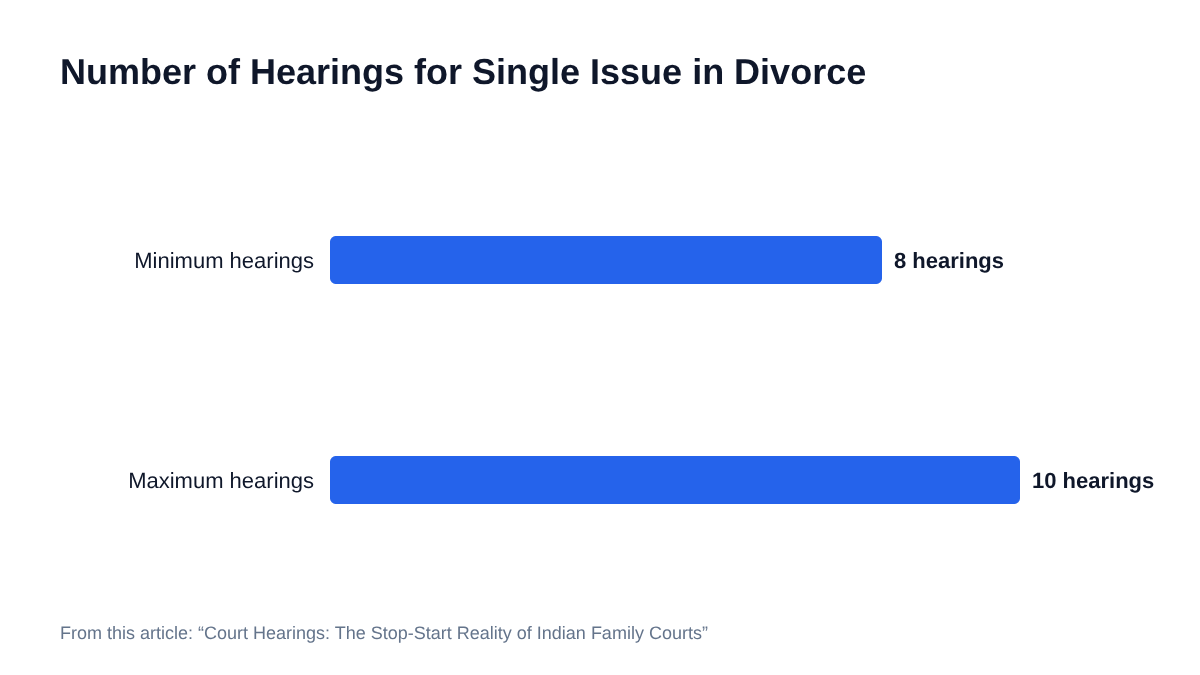
It’s not unusual for a single issue to take 8-10 hearings before it’s decided. Multiply that by three or four issues, and you see why the contested divorce timeline balloons.
Coping with Court Delays
- Always keep copies of all case documents.
- Stay in touch with your lawyer for updates.
- Don’t expect every hearing to be productive.
- Be patient, but don’t let your lawyer slack off.
For anyone expecting a quick fix, the Indian family court process can be a shock. If you’ve ever wondered why those ‘three-month divorce’ promises rarely work, here’s a good explainer: Why Most Three-Month Divorce Promises Fall Apart in Practice.
Can You Speed Up a Contested Divorce? Myths, Loopholes, and Reality
People often ask if there’s any way to cut short the contested divorce timeline. While a few legal loopholes exist, most are not practical for the average case.
Common myths about speeding up divorce:
– Filing in a different city for a ‘faster’ court
– Paying extra for a quick judgment
– Forcing the other spouse to agree
In reality, the court process is designed for fairness, not speed. Judges will not rush through evidence or skip hearings just because you’re in a hurry. There are a few rare cases where the waiting period can be reduced – usually for mutual consent divorces, not contested ones. For more on this, see Legal Loopholes That Could Cut Down Your Divorce Waiting Period.
When Can Contested Divorces Move Faster?
- If both sides agree on some issues and settle them out of court
- When evidence is clear, and both parties cooperate
- If the court invokes special powers (rare)
Otherwise, patience is your only real tool. Some families try mediation for property or custody – this can shave off a few months, but only if both sides genuinely want resolution.
The Emotional and Financial Costs of a Long Divorce
No one talks enough about how draining a long contested divorce can be. The longer the timeline, the more stress, uncertainty, and expense for everyone involved.
Common costs:
– Legal fees (which can double or triple over years)
– Missed workdays for court appearances
– Emotional toll on children
– Strained relationships with extended family
Coping Strategies
- Set realistic expectations from day one.
- Join a support group – many cities have them for divorcees.
- Budget for legal costs, not just living expenses.
- Take care of your mental health. See a therapist if needed.
Honestly, the system isn’t designed for quick healing. But knowing what’s ahead helps you prepare and cope.
Frequently Asked Questions
What is a contested divorce in India?
A contested divorce in India is when one spouse files for divorce but the other does not agree to the separation, or there are unresolved disputes over issues like child custody, alimony, or property division. The court must decide on all contested matters before granting the divorce.
How long does a contested divorce take in India?
A typical contested divorce timeline in India ranges from three to seven years, depending on the complexity of disputes, evidence requirements, court backlog, and whether appeals are filed. Some cases may take even longer if multiple issues are involved.
What are the main reasons for delay in contested divorce cases?
Delays often occur due to multiple court hearings, strict evidence requirements, child custody battles, property division disputes, and frequent adjournments. Lawyer tactics and overloaded court schedules also add to the timeline.
What evidence is required for a contested divorce?
Common evidence includes text messages, emails, financial records, property documents, witness statements, and medical or school records. Each claim must be supported by proof, and both parties can cross-examine the evidence presented.
How are child custody battles handled in Indian courts?
Courts consider the child’s welfare above all. They may order psychological evaluations, review school and medical records, and sometimes interview the child. Both parents’ situations and the child’s wishes (if old enough) are taken into account.
Can property be divided before the divorce is finalised?
Property division is usually decided as part of the divorce judgment. Interim orders may be passed for maintenance or possession, but final division of assets happens only after all evidence is reviewed and the case is decided.
What can I do to speed up my contested divorce?
You can cooperate with the court, avoid unnecessary adjournments, organise your evidence early, and try to settle some issues through mediation. However, there is no guaranteed shortcut for contested divorces in India.
What is the process for a contested divorce in India?
- Filing of divorce petition
- Service of notice to respondent
- Reply and counter-claims
- Framing of issues by the court
- Evidence and witness examination
- Final arguments
- Judgment
Each step can take several months.
Is mutual consent divorce faster than contested divorce?
Yes, mutual consent divorce is much faster, often taking 6 – 18 months if both parties cooperate and agree on all terms. Contested divorce takes much longer due to court intervention in unresolved disputes.
What mistakes should I avoid during a contested divorce?
- Hiding assets or income
- Ignoring court orders
- Using children as leverage
- Missing court dates
- Relying on verbal agreements instead of written settlements
Can a contested divorce be withdrawn?
Yes, the petitioner can withdraw the divorce petition at any time before the final judgment, provided both parties agree. If the respondent objects, the court will decide whether withdrawal is allowed.
How much does a contested divorce cost in India?
Costs vary widely by city and lawyer. On average, legal fees range from ₹75,000 to ₹5 lakh or more, depending on the complexity and length of the case. Additional costs include court fees, document charges, and travel expenses.
What is the role of mediation in contested divorce?
Mediation can help resolve some or all issues such as property or custody, even if the divorce itself remains contested. Successful mediation can reduce the number of court hearings and shorten the overall timeline.
Can I remarry while my contested divorce is pending?
No, you cannot remarry until the final divorce decree is granted by the court and any appeal period has expired. Marrying during a pending divorce is considered bigamy and is illegal in India.
What happens if one party does not appear for court hearings?
The court may proceed ex parte (in the absence of the non-appearing party) after repeated notices. However, this can also cause delays if the absent party later challenges the proceedings or seeks to reopen the case.
Key Takeaways
- A contested divorce timeline in India usually spans three to seven years, often longer.
- Multiple court hearings and adjournments are common, slowing the process.
- Evidence requirements are strict – collect and organise proof early.
- Child custody battles involve detailed investigations and can be emotionally draining.
- Property division delays arise from disputes over assets and missing documents.
- Mediation can resolve some issues but rarely speeds up the entire process.
- Legal fees and emotional costs escalate with each year of delay.
- Lawyer tactics and court overload are frequent sources of frustration.
- There are very few legal loopholes to speed up a contested divorce.
- Setting realistic expectations and preparing mentally helps you cope with the process.
The contested divorce timeline in India is rarely short or simple. Most families are surprised by how many hurdles they face, from evidence collection to property disputes. If you’re starting this journey, go in with your eyes open: patience, preparation, and a clear understanding of the process are your best assets. The system is slow, but knowing the real reasons for delay helps you avoid false hope and wasted effort.