


Why Most Three-Month Divorce Promises Fall Apart in Practice
Ravi and Priya spent months arguing before they finally sat across from a divorce lawyer in Chandigarh. The lawyer, with a reassuring voice, told them, “If you both agree, the divorce can be done in three months.” Priya’s mother clutched her bag tighter, visibly relieved. But that promise, like so many whispered across family court corridors in India, faded fast. Three months turned into eight, then into a year. The reality was nothing like the quick, clean break they’d imagined.
Too many couples get caught in the web of divorce myths India is famous for. The biggest myth? That a mutual consent divorce is always quick – done in three months, start to finish. But that’s rarely the case. Court delays, paperwork, and last-minute drama often turn a simple agreement into a long, exhausting process. If you’re planning to file for divorce, understanding why these promises fall apart can save you from disappointment and wasted energy.
Most promises of a three-month divorce in India collapse because of court delays, unpredictable paperwork, and misunderstandings about the legal process – what sounds fast on paper almost always takes much longer in real life.
Why Three-Month Divorce Promises Rarely Match Real Outcomes
The Origin of the Three-Month Divorce Myth in India
The idea that a mutual consent divorce in India takes exactly three months comes from a misunderstanding of the law and wishful thinking. Section 13B of the Hindu Marriage Act, 1955, says there’s a six-month “cooling-off” period. But some lawyers and online guides still claim you can finish the process in three months.

Direct answer: The three-month timeline is not standard or guaranteed by law. It’s more of a sales pitch than a real promise.
Where Does the Myth Come From?
- Some lawyers, trying to attract clients, give overly optimistic timelines.
- Online articles and word-of-mouth stories often skip the fine print.
- A few rare cases do finish quickly, but these are exceptions, not the rule.
What the Law Actually Says
- Section 13B(2) requires a six-month gap after the first motion before the second motion can be filed.
- The Supreme Court allows this period to be waived in special circumstances, but it’s not automatic.
- Every state, city, and even individual judge may interpret the rules differently.
Why Do People Believe It?
- Divorce is stressful. People want hope and quick relief.
- Many don’t have time to read the full law or check real-world timelines.
- Even some lawyers don’t warn clients about delays, hoping to keep their business.
Honestly, if someone promises a guaranteed three-month divorce, I’d ask for a written guarantee – nobody gives that.
The Real Timeline: What Actually Happens in Indian Family Courts
Most divorces in India, even mutual consent ones, take longer than three months. The process is packed with steps, each with its own waiting period.
Direct answer: Even in the best-case scenario, mutual consent divorces usually take 8 – 12 months from start to finish, and contested divorces can stretch for years.
Typical Steps in a Mutual Consent Divorce
- Both spouses agree and file the first motion petition.
- The court schedules a hearing, usually 2 – 6 weeks later.
- The six-month “cooling-off” period begins.
- After six months, the second motion is filed.
- The court hears the second motion and passes the decree – if everything is in order.
What Slows Things Down?
- Court backlog: Many family courts have thousands of pending cases. Your file waits its turn.
- Holidays and strikes: Courts close for festivals, summer, and sometimes sudden bar strikes.
- Missing paperwork: A single missing document can push your date back by weeks.
- Judge transfers: If your judge is transferred, you might have to start again with a new one.
Real Examples
- Priya and Ravi, who thought they’d finish in three months, waited nine for their first hearing because their court had a huge backlog.
- In Chandigarh, some couples have managed a quick divorce in five months, but only by pushing for a waiver and having all documents ready.
If you want a more detailed breakdown, check out Divorce Timelines in India: Breaking Down the Real-World Roadblocks. It’s an eye-opener.
Mutual Consent Divorce: Legal Hurdles and Common Pitfalls
Mutual consent sounds simple, but the ground reality is full of traps. Many couples run into problems because of incomplete agreements, sudden changes of heart, or legal mistakes.
Direct answer: Mutual consent divorces often get delayed by incomplete paperwork, disagreements about terms, or a spouse suddenly refusing to cooperate.
Common Pitfalls
- Incomplete settlement: Property, alimony, and child custody must be agreed upon fully. If not, the court won’t grant the divorce.
- Change of mind: Either party can withdraw consent at any point before the final decree. If that happens, the process collapses.
- Wrong jurisdiction: Filing in the wrong court means starting again from scratch.
Legal Hurdles
- Some courts insist on physical presence for both hearings. If one spouse is abroad, arranging travel can add months.
- If there’s a minor child, the court may ask for more documents or conduct an inquiry.
- Waiver of the six-month period is only granted in rare cases, and only if the court is convinced the marriage is truly beyond repair.
Divorce Lawyer Advice: How to Avoid Delays
- Make sure ALL terms – money, property, and custody – are written and signed before filing.
- Double-check which court has jurisdiction (usually where you last lived together).
- Prepare all documents: marriage certificate, address proof, photos, settlement agreement, and proof of separation.
- If you want to waive the six-month period, collect evidence of long separation or failed attempts at reconciliation.
Most lawyers will tell you, “Be ready for surprises.” That’s not pessimism, just experience.
Court Backlog and Family Court Delays: The Hidden Obstacles
Even if your paperwork is perfect, the court system itself is a major source of delay. Family courts across India are stretched thin.
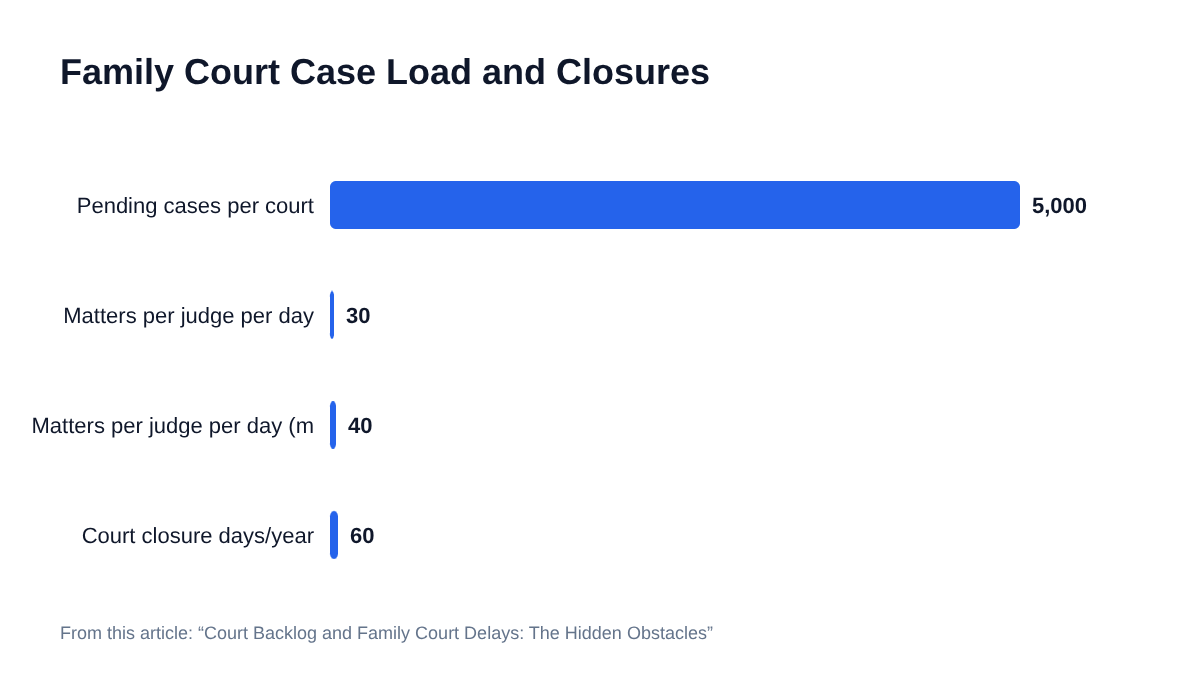
Direct answer: Court backlog and staff shortages mean that even simple divorce cases get delayed for months, regardless of how cooperative the couple is.
Family Court Realities
- In cities like Delhi, Mumbai, and Bangalore, family courts can have up to 5,000 pending cases each.
- A single judge may hear 30 – 40 matters in one day. Each case gets just a few minutes.
- If a judge is transferred, your case may be reassigned and re-heard.
Other Court-Related Delays
- Adjournments: If either party or their lawyer can’t appear, the hearing is postponed.
- Court holidays: Courts close for about 60 days a year, not counting weekends.
- Administrative delays: Lost files, strikes, and computer system breakdowns are not uncommon.
What Can Be Done?
- Some states have started digital filing and video hearings, but coverage is patchy.
- Hiring a local lawyer who knows the specific court’s rhythm can shave off some waiting time.
- Persistence helps. Regular follow-ups and polite reminders to court staff sometimes move files faster.
If you’re hoping for a smooth ride, be ready for bumps. Even the best lawyer can’t change how slowly the system moves.
Quick Divorce Reality vs. Marketing Promises: What Lawyers Don’t Always Tell You
Many people expect a quick divorce because of what they read online or hear from friends. The reality is more complicated.

Direct answer: Most quick divorce promises are marketing tactics, not legal guarantees. Real-world timelines depend on many things outside your or your lawyer’s control.
What Gets Promised
- “We’ll get you divorced in three months, guaranteed.”
- “No need to appear in court, we’ll handle everything.”
- “All paperwork done for you, no hassle.”
The Reality
- Courts usually require both spouses to appear at least twice.
- Even the simplest mutual consent divorce can take 8 – 12 months, depending on court workload.
- If any document is missing or a spouse can’t attend, the process stops until the issue is fixed.
How to Spot Unrealistic Promises
- Ask for a written timeline and check if it matches what the law says.
- If a lawyer says the six-month period will always be waived, be skeptical.
- No lawyer, however experienced, can control court holidays, judge transfers, or sudden strikes.
How You Can Push for Speed
- Prepare all documents and agreements before filing.
- Be flexible with dates and ready to attend hearings at short notice.
- If you qualify, ask your lawyer about the process for waiving the cooling-off period. The Legal Loopholes That Could Cut Down Your Divorce Waiting Period article covers this well.
Mutual Consent Pitfalls: Why Agreements Collapse at the Last Minute
Even after months of negotiation, mutual consent divorces can still fall apart. Emotions run high, and trust can vanish quickly.
Direct answer: Many mutual consent divorces fail at the last minute because one spouse withdraws consent or new disagreements pop up, forcing the process to start over.
Common Last-Minute Problems
- One spouse changes their mind about alimony or custody.
- Family elders pressure someone to withdraw consent.
- Sudden allegations of domestic violence or dowry harassment.
- New financial or property disputes come up after the first motion is filed.
What Happens When Consent Is Withdrawn?
- The court cannot grant a mutual consent divorce if both parties don’t agree at every stage.
- The only option is to file a contested divorce, which can take years.
- All previous agreements become void, and the process starts from scratch.
Tips to Prevent Last-Minute Collapse
- Put every agreement in writing and get it signed before filing.
- Discuss every possible issue – future claims, property, child visits – before going to court.
- Avoid making promises you can’t keep, even to “keep the peace.”
Legal Hurdles and Paperwork: What Really Slows Things Down
Paperwork may sound boring, but it’s the backbone of every divorce case. Even one missing paper can hold things up for weeks or months.
Direct answer: Incorrect or missing documents, wrong jurisdiction, or incomplete agreements are the most common paperwork mistakes that delay divorce cases in India.
Essential Documents for Divorce
- Marriage certificate (original and photocopy)
- Proof of address for both parties
- Four to six passport-sized photos each
- Joint settlement agreement (covering alimony, property, and custody)
- Proof of separation (rental agreements, affidavits, or witness statements)
Common Mistakes
- Filing in the wrong court (jurisdiction is usually where you last lived together)
- Incomplete settlement agreement (missing out on minor assets or debts)
- Not updating all documents with current addresses and names
- Forgetting to include details for minor children
How to Avoid Paperwork Delays
- Double-check every document with your lawyer before filing
- Keep multiple copies of each document, both digital and physical
- Confirm that all names and addresses match across documents
- Prepare for the possibility that the court may ask for more proof
Divorce Myths India: What Most People Still Get Wrong
Despite endless legal blogs and WhatsApp forwards, several myths about divorce timelines still float around in India. These myths cause most of the heartbreak and confusion.
Direct answer: The biggest divorce myths in India are that mutual consent always means a quick divorce, that courts will always waive waiting periods, and that lawyers can guarantee timelines.
Top Divorce Myths in India
- Three-month guarantee: As discussed, this is rarely true.
- No court appearance needed: Most courts still require both parties to appear in person.
- Lawyer can speed up the process: A good lawyer helps, but can’t change the court’s pace.
- Six-month period always waived: Courts only waive this if there’s a strong reason.
- Divorce is always bitter and public: Mutual consent divorces are usually private, but messy cases do get public.
Why Do These Myths Persist?
- People trust stories from relatives or neighbors more than official sources.
- Some lawyers over-promise to get business.
- Social stigma keeps people from asking detailed questions about the process.
Frequently Asked Questions
What is the minimum time for mutual consent divorce in India?
The minimum time for a mutual consent divorce in India is usually six months, as per Section 13B of the Hindu Marriage Act. In rare cases, courts may waive this period if both parties prove long separation and failed reconciliation efforts. However, most divorces take longer due to court workload and paperwork.
Can the six-month cooling-off period be waived?
Yes, the Supreme Court allows family courts to waive the six-month cooling-off period in special circumstances. Both parties must show that the marriage is beyond repair and that all issues, like alimony and custody, are settled. The waiver is not automatic and depends on the judge’s discretion.
Why do mutual consent divorces take longer than promised?
Mutual consent divorces often take longer because of court backlog, missing documents, or disagreements that arise after filing. Even if both parties cooperate, procedural delays and court holidays can extend the timeline well beyond three months.
What are the common legal hurdles in Indian divorce cases?
Common legal hurdles include incomplete settlement agreements, incorrect jurisdiction, missing paperwork, and one spouse withdrawing consent. Problems like judge transfers, holidays, and administrative delays also slow down cases.
Is it possible to get a divorce without appearing in court?
In most Indian courts, both parties must appear in person for at least two hearings. Some courts have started video hearings, but these are not available everywhere. Physical appearance is still the norm for most cases.
How can I speed up my divorce process in India?
You can speed up your divorce by preparing all documents in advance, reaching a full settlement before filing, and hiring a local lawyer familiar with the specific court. If eligible, request a waiver of the six-month period with strong evidence of separation.
What happens if one spouse withdraws consent before the final hearing?
If either spouse withdraws consent before the second motion, the mutual consent divorce cannot proceed. The only option left is to file a contested divorce, which takes much longer and is usually more stressful.
Are there any legal loopholes to shorten divorce waiting periods?
Some legal loopholes, like requesting a waiver of the six-month cooling-off period, can shorten the waiting time. Courts may grant this if both parties prove they have lived apart for a long time and all issues are settled. Read more at Legal Loopholes That Could Cut Down Your Divorce Waiting Period.
What documents are required for a mutual consent divorce?
Essential documents include the marriage certificate, address proof, passport-sized photos, a signed settlement agreement, and proof of separation. Missing any of these can delay the process.
How does court backlog affect divorce timelines?
Court backlog leads to longer waiting times for hearings and judgment. Even simple cases get delayed when courts have thousands of pending matters. This is a major reason why three-month promises rarely work out.
What’s the difference between mutual consent and contested divorce?
Mutual consent divorce requires agreement from both parties and is generally faster. Contested divorce happens when one party disagrees, leading to a much longer and more complicated process with multiple hearings and evidence.
Can I file for divorce in a city where I don’t live?
You must file for divorce in the family court that has jurisdiction – usually where you last lived together as a couple. Filing in the wrong court will waste time and force you to start over.
How much does a mutual consent divorce cost in India?
Costs vary by city and lawyer, but a typical mutual consent divorce in India can range from ₹20,000 to ₹1,00,000 or more. Additional costs may arise if extra hearings or documentation are needed.
How do family court delays impact child custody cases?
Family court delays can postpone decisions about child custody, leaving children in limbo for months. Courts usually prioritize custody, but backlog still causes significant waiting.
What should I do if I want a fast divorce?
Prepare all documents, reach a full settlement, and ask your lawyer if you qualify for a waiver of the cooling-off period. Be proactive and attend all hearings as scheduled to avoid further delays.
Key Takeaways
- Three-month divorce promises are rarely true in India.
- Mutual consent divorces usually take 8 – 12 months, not three.
- Court backlog and holidays add months to the process.
- Paperwork mistakes are a top cause of delays.
- The six-month cooling-off period can only be waived in special cases.
- Both parties must be present for hearings in most courts.
- Mutual consent can fail if either spouse withdraws agreement.
- Legal loopholes exist, but don’t count on them.
- Costs vary, but unexpected delays often increase expenses.
- Always check jurisdiction before filing.
- A good lawyer helps, but cannot guarantee a timeline.
- Divorce myths India are everywhere – check facts before believing promises.
- Family court delays affect child custody and property division too.
- Written agreements and full document sets prevent surprises.
- Persistence and preparation are your best tools for a smoother process.
Divorce in India is rarely quick or simple, even when both sides agree. The real hurdles are court backlog, missing paperwork, and last-minute changes of heart. If you’re planning to file, it’s better to expect a year-long process and be pleasantly surprised if it finishes sooner. The best protection against disappointment is doing your homework and not falling for easy promises. That’s the honest quick divorce reality.
