


Divorce Timelines in India: Breaking Down the Real-World Roadblocks
You’re sitting in a cramped family court corridor in India, sweating through a sticky May afternoon, watching the clock crawl by. Maybe it’s your first hearing. Maybe it’s your fifth. Either way, you’re not alone. Thousands of couples every year ask the same question: why does the divorce process in India take so long, and is there any way to speed it up? The reality is, divorce here is rarely as quick as people hope. Even when both sides agree, the timeline can stretch for months – or years – thanks to legal technicalities, overloaded courts, and sometimes, plain old drama.
For anyone tangled in a marriage that’s run its course, understanding the real-world divorce process timeline is not just useful – it’s essential. It affects your finances, your living situation, even your mental health. And with divorce law in India involving a maze of steps, cooling off periods, and sometimes endless paperwork, knowing what to expect can save you a lot of stress. I’ve seen friends and relatives go through this, and honestly, most people underestimate how much patience you need.
If you’re searching for clear answers about divorce in India – how long it takes, what actually causes delays, and whether a fast track divorce is even possible – you’re in the right place. We’ll break down the real numbers, bust some myths, and share the workarounds people use (legally, of course) to avoid spending years stuck in limbo.
The average timeline for divorce in India ranges from 6 months for mutual consent cases to 3 – 5 years or longer for contested divorces, with delays often caused by court backlogs, documentation errors, and disagreements over property or custody.
How Divorce Timelines Really Work in India
Divorce in India isn’t just about two people deciding to split. The process is built on layers of legal steps, each with its own rules and waiting periods. On paper, things look straightforward. In real life, they’re not.
Types of Divorce and Their Typical Timelines
There are two main types of divorce under Indian law: mutual consent and contested. The divorce process timeline depends almost entirely on which path you take.
Mutual Consent Divorce: The Shorter Route (Usually)
A mutual consent divorce is when both spouses agree to end the marriage and settle issues like property and custody without a fight. This is supposed to be the quick option. Here’s how it usually goes:
- Filing the joint petition: Both parties file together in family court.
- Cooling off period: The law requires a 6-month waiting period (cooling off period) between the first and second motion. This is meant to give couples a chance to reconsider.
- Second motion and final hearing: After 6 months, the couple appears again. If neither side changes their mind, the court grants the divorce.
- Paperwork and decree: The divorce decree is issued – sometimes on the spot, sometimes after a further wait for paperwork.
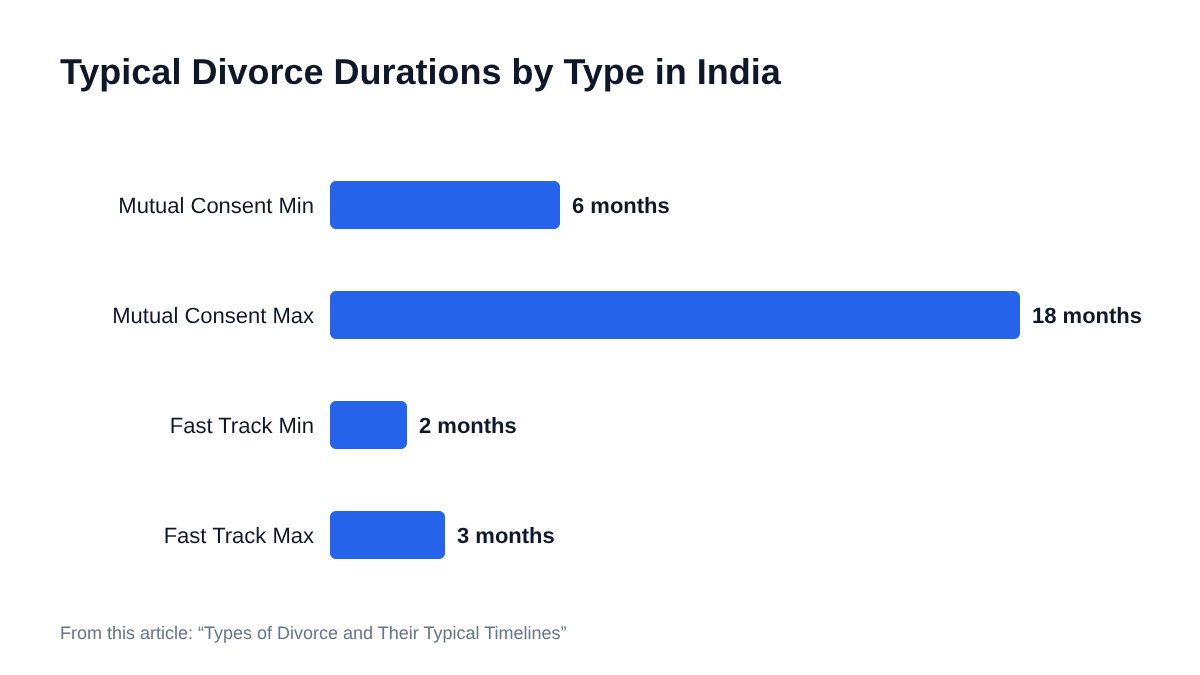
Typical mutual consent divorce duration: 6 – 18 months. Some courts allow the cooling off period to be waived in special cases, bringing it down to 2 – 3 months. But don’t count on it unless you have strong reasons.
Contested Divorce: The Long Haul
A contested divorce is what most people dread. Here, one spouse wants a divorce and the other doesn’t, or there’s a dispute over money, custody, or property. The process drags because:
- Each side files petitions and counter-petitions.
- Multiple hearings are scheduled, sometimes months apart.
- Evidence and witnesses are called.
- The court may order mediation, which can add months.
Typical contested divorce duration: 3 – 5 years, sometimes longer. Delays often come from overloaded family court procedures, missing documents, or parties not showing up.
Table: Typical Divorce Timelines in India
| Divorce Type | Minimum Duration | Common Delays | Maximum Duration |
|---|---|---|---|
| Mutual Consent | 6 months | Paperwork, court backlog | 18 months |
| Contested | 3 years | Evidence, mediation, appeals | 5+ years |
| Fast Track/Expedited | 2 – 3 months* | Only if cooling off is waived | Case-specific |
*Only possible in rare, special situations (see Legal Loopholes That Could Cut Down Your Divorce Waiting Period).
The Legal Separation Period and Cooling Off Rules
One of the most misunderstood parts of divorce law India is the legal separation period and cooling off period. People mix them up all the time, but they’re not the same.

Legal Separation Period: The Starting Point
Most divorce laws in India require that the couple live separately for at least one year before filing for divorce. This is the legal separation period. It’s meant to show that the marriage has truly broken down.
- Under the Hindu Marriage Act, couples must be separated for at least one year before even filing.
- For Christian marriages, it’s two years.
- Muslim law has its own rules, often involving talaq and iddat periods.
It’s not about living in different cities. Even living under the same roof but not as husband and wife can count, if you can prove it.
Cooling Off Period: The Last Chance Pause
After filing for mutual consent divorce, the law says you must wait at least 6 months before the court can grant the final decree. This is the cooling off period. The idea is to give couples a final window to reconcile.
- Some courts waive this period if both sides insist and can show there’s no chance of patching up.
- In 2017, the Supreme Court said the cooling off period is not mandatory if the court is satisfied the marriage is dead.
- In reality, most courts still require strong proof to skip this step.
Common mistake: People think you can file for divorce as soon as you decide to separate. But unless you’ve completed the legal separation period, the court won’t even accept your petition.
Step-by-Step: The Divorce Process Timeline in India
Understanding each stage helps you predict where delays might happen. Here’s a typical sequence for both mutual consent and contested divorces.
1. Pre-Filing Separation
- Live separately for the required legal separation period (usually 1 year).
- Collect evidence of separation (rental agreements, utility bills, or witness statements).
2. Filing the Petition
- Draft and file the divorce petition in the appropriate family court.
- For mutual consent, both sign. For contested, one files and the other is served a notice.
3. First Hearing
- Court checks paperwork, may ask questions.
- In mutual consent, records statements from both.
- In contested, the other party files a response.
4. Mediation and Reconciliation
- Court may order mediation to see if the marriage can be saved.
- If unsuccessful, move to the next stage.
5. Evidence and Arguments
- Both sides submit evidence.
- Witnesses may testify.
- Lawyers argue the case.
6. Cooling Off Period (Mutual Consent Only)
- Wait 6 months after first motion.
- Some courts may waive this in special cases.
7. Second Motion (Mutual Consent Only)
- Both appear again.
- Court confirms consent hasn’t changed.
8. Final Judgment
- Judge issues the divorce decree.
- May take weeks to receive the official document.
9. Appeals (Contested Only)
- Either side can appeal within 90 days. This can drag the case for years.
The Role of Family Court Procedures and Systemic Delays
Family courts in India were meant to simplify things. In reality, they’re often swamped. Here’s why timelines get stretched:
- Heavy caseloads: Many family courts handle hundreds of cases a month.
- Scheduling gaps: Hearings are sometimes set months apart.
- Documentation errors: Missing or incorrect paperwork can push your case back.
- Non-appearance: If either party misses a hearing, the date is rescheduled, adding months.
- Adjournments: Lawyers sometimes ask for more time, especially in contested cases.
- Holidays: Court holidays and staff shortages can add hidden delays.
Tip: Double-check all your documents before filing. Something as silly as a missing affidavit can mean a 3-month wait for the next slot.
Fast Track Divorce: Is It Possible in India?
People often ask if there’s a fast track divorce option. The answer? Sometimes, but only in limited situations.

When Fast Track Divorce Might Work
- Mutual consent with no property or child disputes
- Both parties living abroad or with urgent reasons
- Cases involving cruelty, desertion, or clear grounds for divorce
Some courts, especially in metros, may waive the cooling off period if you can show:
– The marriage is truly dead.
– Both sides have settled everything.
– There’s no chance of reconciliation.
But: There’s no guarantee. Each judge interprets the law differently. You’ll need a good lawyer and solid documentation. For more on this, check out Legal Loopholes That Could Cut Down Your Divorce Waiting Period.
What About Online or One-Day Divorces?
Ignore the online ads promising instant divorce. Indian law requires physical presence for statements and hearings. At best, online platforms can help draft documents or connect you to a lawyer.
Grounds for Divorce and Their Impact on Timelines
Your choice of grounds for divorce in India can make a big difference to how long things take.
Common Grounds for Divorce
- Cruelty (mental or physical)
- Adultery
- Desertion (at least 2 years)
- Conversion to another religion
- Mental disorder
- Renunciation of the world
- Presumed death (missing for 7 years)
For mutual consent, the ground is simply irretrievable breakdown of marriage.
How Grounds Affect Duration
- Allegations like cruelty or adultery require evidence, which means more hearings and longer timelines.
- Desertion cases can take longer because you must prove the other person left you for the required period.
- Mutual consent skips most of this, but only if both sides cooperate.
Mistake to avoid: Filing on the wrong ground or without enough proof can get your case dismissed or delayed.
Common Mistakes and How to Avoid Delays
Most people make at least one error that slows things down. I’ve seen it up close. Here’s what to watch out for:
- Incomplete paperwork: Even a missing signature can mean months of delay.
- Not preparing for mediation: Courts push for reconciliation. If you’re not ready, you’ll waste time.
- Ignoring financial and custody agreements: The court won’t grant divorce if these aren’t settled.
- Not showing up for hearings: If you or your lawyer skip a date, the next one could be months away.
- Changing lawyers mid-way: This can confuse things and lead to repeat arguments.
Best practices:
– Double-check all documents with your lawyer.
– Prepare a clear, written settlement on property, money, and custody.
– Keep all notices and summons organized.
– Attend every hearing, even if you think nothing will happen.
Trends and Future Outlook: Are Timelines Improving?
In the last few years, Indian courts have tried to speed things up. But progress is uneven.
Recent Developments
- The Supreme Court has allowed waiving the cooling off period in some mutual consent cases.
- Some states are experimenting with online case tracking and e-filing to cut paperwork delays.
- Family courts in larger cities now have special mediation centers to resolve disputes faster.
Ongoing Challenges
- Smaller towns and rural courts are still bogged down by heavy caseloads.
- Laws haven’t changed much, so the minimum timelines remain.
- Social stigma and family pressure can make people hesitate, stretching things out.
What’s Next?
There’s talk about introducing a true fast track divorce process, especially for cases with no children or assets to divide. But for now, patience is still the main requirement.
Frequently Asked Questions
What is the minimum time required for divorce in India?
The minimum time for divorce in India is 6 months for a mutual consent divorce, due to the mandatory cooling off period. In rare cases, courts may waive this period, reducing the timeline to around 2 – 3 months if both parties show there’s no chance of reconciliation.
How long does a contested divorce take in India?
A contested divorce in India usually takes 3 – 5 years, sometimes longer. Delays are common due to multiple hearings, evidence collection, mediation, and appeals. Complex cases involving property or child custody can stretch even further.
Can the cooling off period be waived in mutual consent divorce?
Yes, the Supreme Court has ruled that the 6-month cooling off period can be waived if the court is convinced the marriage is beyond repair. Couples must apply for the waiver and provide strong reasons and proof of settlement.
What are the main grounds for divorce in India?
Common grounds for divorce in India include cruelty, adultery, desertion, conversion to another religion, mental disorder, renunciation, and presumed death. For mutual consent divorce, the ground is typically irretrievable breakdown of marriage.
What is the process for mutual consent divorce in India?
- Live separately for at least one year.
- File a joint petition in family court.
- Attend the first motion hearing.
- Wait for the 6-month cooling off period.
- Attend the second motion hearing.
- Receive the final divorce decree.
How does property get divided in Indian divorce cases?
Property division depends on mutual agreement or, in contested cases, on court orders. Courts usually try to ensure fairness, considering contributions and needs. There’s no automatic 50-50 split, and laws can differ for Hindus, Muslims, Christians, and others.
Can NRIs or people living abroad file for divorce in India?
Yes, NRIs can file for divorce in India if the marriage was registered here or if one party resides in India. Courts may allow some hearings by video conference, but physical appearance is often required for statements.
Is online divorce legal in India?
Online divorce is not legally recognized in India. While some tasks like document drafting or consultation can be done online, actual hearings and statements must be in person at the family court.
What happens if one spouse doesn’t attend the court hearings?
If a spouse misses hearings, the court may adjourn the case or, after repeated absences, proceed ex-parte (deciding in their absence). This can delay the process, so regular attendance is important.
Can I remarry immediately after getting a divorce in India?
You must wait until the divorce decree is final and the appeal period (usually 90 days) has passed. Marrying during the appeal window can lead to legal complications if the other party challenges the divorce.
How much does a divorce cost in India?
Costs vary widely. Mutual consent divorces may cost Rs. 30,000 – 1,00,000 or more, while contested cases can run into lakhs due to prolonged legal fees, documentation, and court appearances.
What’s the difference between legal separation and divorce?
Legal separation means living apart but still being legally married. Divorce ends the marriage completely. In India, legal separation is often a required step before filing for divorce.
How can I speed up my divorce process in India?
- Choose mutual consent if possible.
- Settle property and custody issues beforehand.
- Ensure all documents are complete.
- Attend all hearings.
- Apply for waiver of cooling off period if eligible.
What happens to child custody during divorce in India?
Courts prioritize the child’s welfare. Custody can be joint or sole, and visitation rights are common. Parents are encouraged to reach an agreement, but the court makes the final decision.
Which courts handle divorce cases in India?
Family courts in each district handle divorce cases. Some metro cities have dedicated family court complexes, while smaller towns may hear cases in regular district courts.
Key Takeaways
- The average divorce process timeline in India is 6 – 18 months for mutual consent and 3 – 5 years for contested cases.
- The legal separation period is mandatory before filing for divorce in most cases.
- The cooling off period can sometimes be waived, but only with court approval and strong evidence.
- Contested divorces are much longer due to hearings, evidence, and appeals.
- Common delays include court backlogs, missing paperwork, and non-appearance.
- Fast track divorce is rare but possible in special circumstances.
- Property and custody agreements, if settled early, can speed up the process.
- Grounds for divorce affect both the process and duration.
- Online divorces are not recognized by Indian law.
- Legal costs vary widely, with contested divorces being much more expensive.
- Family court procedures and local practices matter a lot for timelines.
- NRIs can file for divorce in India but must meet certain criteria.
- Appeals and ex-parte proceedings can add years to the process.
- Child custody is decided based on the child’s welfare, not just parental preference.
- Patience and preparation are key to avoiding unnecessary delays.
For most people facing divorce in India, the reality is slower and more complicated than they expect. Even with a mutual consent divorce, you’ll need to plan for months of paperwork and at least two court visits. Contested cases can stretch on for years, especially if children or property are involved. The best way to avoid endless delays is to prepare thoroughly, settle as much as possible outside court, and keep your paperwork spotless. If you’re hoping for a quick fix, check if you qualify for a cooling off period waiver – but be ready to prove your case. Above all, patience is your best friend during this process.
