
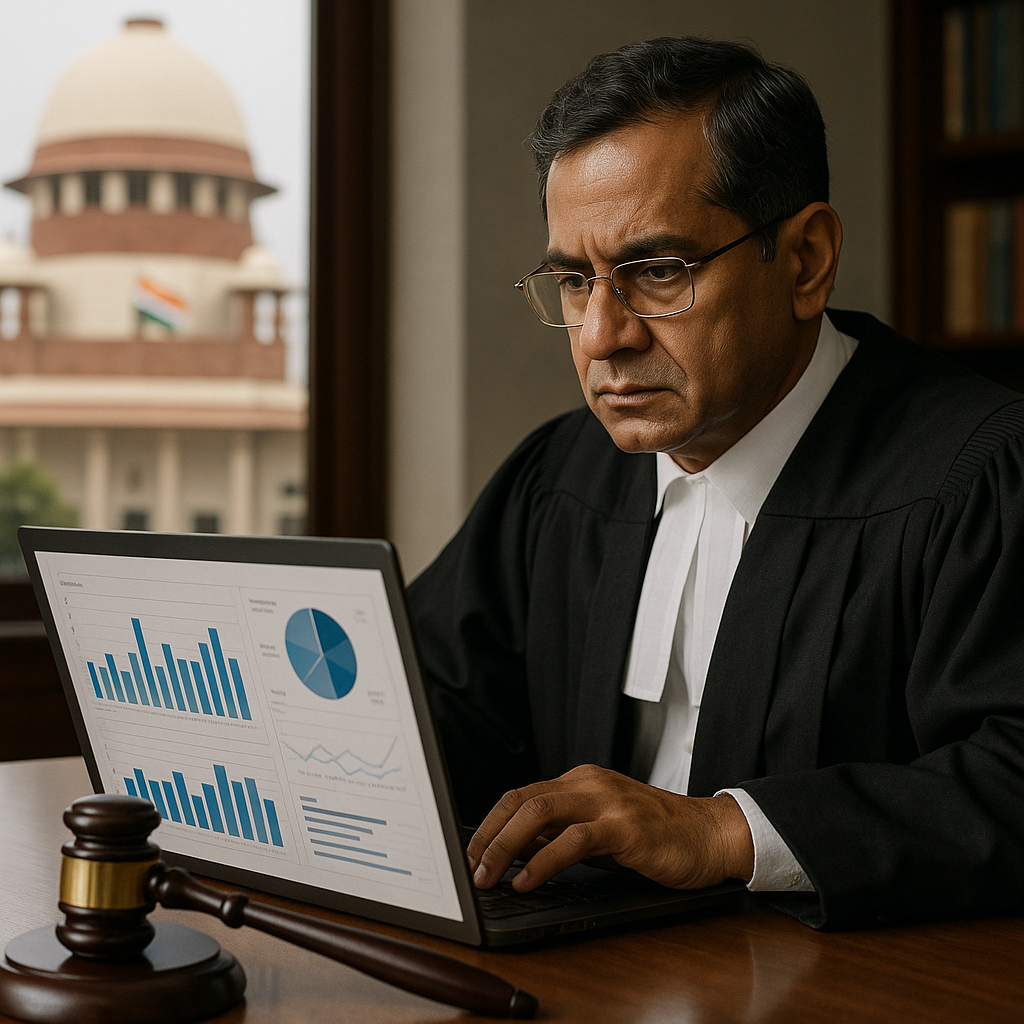
What Surprised Us About Judge Consistency in Indian Supreme Court Rulings
Most lawyers in India have a story about a Supreme Court case that seemed to hinge on which bench heard it. You prep, you research, you cite every precedent, but still, the outcome can feel like a coin toss. Why do two judges, both trained and experienced, sometimes reach opposite conclusions on nearly identical facts? For years, this question floated around late-night discussions in Delhi law firms and WhatsApp groups of young advocates. But with the rise of judge consistency analytics and legal data tools, we finally have numbers to back up – or challenge – those hunches.
Turns out, the patterns in judicial decision-making at the Supreme Court of India are not always what you’d expect. The new data-driven lens reveals both surprising consistencies and eyebrow-raising variations in how cases are decided. These findings matter not just for academics, but for anyone preparing a brief, planning litigation strategy, or simply trying to understand the Indian judiciary better.
Judge consistency analytics show that while some Supreme Court justices in India are remarkably predictable in their rulings, others display significant swings, with decision patterns that can shift sharply depending on case type, co-judges, or even the time of year.
What We Learned About Judge Consistency in the Indian Supreme Court
The Basics of Judge Consistency Analytics
Judge consistency analytics refers to the use of data science techniques to measure how reliably a judge rules in similar ways when faced with comparable cases. In India, this approach has gained ground only recently, thanks to digitised court records and advances in legal analytics platforms like SCC Online and Indian Kanoon.
At its core, this method tries to answer questions such as:
– Does Judge X rule the same way in similar criminal appeals?
– Are there clear patterns in how certain benches decide constitutional questions?
– Can we predict a case outcome based on a judge’s past rulings?
The process involves mining thousands of Supreme Court judgments, tagging them by issue, outcome, parties, and bench composition, then running statistical analysis for patterns. For the Indian context, this also means accounting for regional diversity, evolving laws, and the sheer volume of cases (over 60,000 pending at the apex court as of 2024).
Tools and Techniques Used
- Natural Language Processing (NLP): Extracts key facts and reasoning from judgments.
- Clustering Algorithms: Groups cases by similarity for comparison.
- Outcome Trend Analysis: Tracks how often a judge grants or denies appeals in specific domains.
- Co-Judge Impact Studies: Examines if a judge’s consistency changes when sitting with different colleagues.
Honestly, the tech part is impressive, but the real shocker is what the numbers actually reveal.
Surprising Patterns in Judicial Decision Consistency
When you look at the data, some things defy the usual assumptions held by lawyers and litigants. Not all judges are equally predictable, and the same judge can show different levels of consistency depending on the legal domain.
Key findings from recent judiciary analysis:
- Some justices have over 85% decision consistency in areas like tax or service law, but drop to 60% or less in criminal or constitutional matters.
- Judges who frequently write dissenting opinions tend to show lower overall consistency but higher consistency within their own dissents.
- Bench composition matters more than most lawyers assume. A judge paired with certain colleagues might change their voting pattern by up to 20%.
- Case load and time of year (think: pre-retirement rush) can create spikes in decision variability.
Case Study: Justice G’s Record in Criminal Appeals
Take Justice G (not real initials) – from 2016-2023, their rulings in criminal appeals aligned with precedent 92% of the time. But when sitting with Justice D, that number dropped to 71%. The reason? Their joint benches tackled more controversial cases where precedent was less clear. This sort of nuance is easy to miss without analytics.
Comparison Table: Consistency by Legal Domain (Sample Data)
| Legal Domain | Avg. Consistency (%) | Highest Judge | Lowest Judge |
|---|---|---|---|
| Tax Law | 88 | 93 | 72 |
| Service Matters | 84 | 90 | 67 |
| Criminal Law | 63 | 82 | 55 |
| Constitutional | 59 | 77 | 41 |
These numbers aren’t perfect, but they do paint a picture: decision consistency is not uniform, and some areas are much harder to predict than others.
Why Judge Consistency Matters in the Supreme Court
Predictability in judicial decision patterns is not just an academic concern. For lawyers, clients, and even judges themselves, consistency means fairness, transparency, and trust in the legal system. When outcomes are wildly unpredictable, litigants lose confidence – and so do foreign investors watching India’s legal climate.
Direct answer: Decision consistency helps ensure similar cases are treated similarly, which is a basic principle of justice. Too much unpredictability can hint at judge bias, hidden factors, or system inefficiencies.
Impacts on Stakeholders
- Lawyers: Can better advise clients on likely outcomes, saving time and money.
- Litigants: Feel reassured that the law applies equally, not based on luck.
- Judges: Can reflect on their own patterns and avoid unconscious bias.
- Policy Makers: Use analytics to spot problem areas needing reform.
But there’s a flip side. Some inconsistency is natural and even healthy. The law evolves, and not every case is identical. Overly rigid consistency can stifle the development of new legal principles.
Risk of Misreading the Data
One big warning: analytics can only measure what’s in the data. Sometimes, a low consistency score just means the judge is handling novel or complex cases. Not every swing is a sign of bias or error.
Judge Bias vs. Genuine Legal Evolution
It’s tempting to see every inconsistency as evidence of judge bias. But the truth is a bit more complicated. Some shifts are a sign of the law growing in response to new social realities.
Direct answer: Analytics can help spot outlier judges or trends, but context is key. Not all deviations are negative.
Types of Judge Bias Detected
- Personal Prejudice: Rare, but shows up in outlier dissents or repeated departures from precedent.
- Issue-Based Leanings: Some judges are strict on bail, lenient on tax, or conservative on free speech.
- Bench Influence: A judge’s pattern changes when paired with a senior or more vocal colleague.
Legal Evolution in Action
For example, the decriminalisation of Section 377 (homosexuality) saw several judges shift their stance over a decade. Initial inconsistency was not bias, but the law catching up with evolving social values.
Challenges in Distinguishing the Two
- Data Blind Spots: Not all factors (like oral arguments or courtroom dynamics) are captured in written judgments.
- Changing Laws: Amendments or new precedents can reset the baseline for consistency.
- Sample Size: Some judges handle more high-profile or controversial cases, skewing their numbers.
How Legal Analytics Tools Are Changing Litigation Research
Legal analytics platforms have become a for Indian lawyers in the last five years. What started as a way to search judgments is now a tool for deep judiciary analysis.
Direct answer: Modern tools can now predict likely case outcomes, flag inconsistent benches, and help lawyers tailor arguments for specific judges.
Popular Legal Analytics Tools in India
- SCC Online: Now offers judge analytics dashboards.
- Indian Kanoon: Tracks outcome trends by judge and topic.
- Manupatra: Provides bench composition and precedent tracking.
- Judy: A newer AI-driven platform for pattern spotting.
Key Features Useful for Judge Consistency Analytics
- Outcome prediction by judge and issue type
- Visualisation of decision swings over time
- Heatmaps showing co-judge influence
- Alerts for sudden changes in a judge’s trend
Practical Uses for Lawyers and Researchers
- Checking if a judge has a history of reversing certain types of lower court rulings
- Identifying which benches are more likely to split
- Spotting areas where legal arguments need to be extra robust due to low consistency
Common Misconceptions About Judicial Decision Patterns
The rise of legal analytics has created its own set of myths. Here are a few that crop up again and again.
Direct answer: Not all patterns mean bias, and not all variability is bad. Judge consistency analytics must be interpreted with care.
Top Misconceptions
- Myth 1: High consistency always means fairness.
- Reality: Sometimes it just means the judge is handling routine, uncontested matters.
- Myth 2: A judge with low consistency is biased.
- Reality: They might handle more complex or precedent-setting cases.
- Myth 3: Decision patterns can predict every outcome.
- Reality: Human judgment, new arguments, and social shifts still matter.
- Myth 4: All legal analytics tools are equally reliable.
- Reality: Some platforms use incomplete data or outdated tagging systems.
How to Avoid These Mistakes
- Always check the context of the cases included in the analysis.
- Use analytics as one input, not the final word.
- Compare across multiple tools if possible.
Best Practices for Using Judge Consistency Analytics in Litigation Research
If you’re a lawyer or academic, using judge consistency analytics can be a real advantage – if you do it right.
Direct answer: Combine analytics with traditional legal research and always interpret the numbers with context in mind.
Step-by-Step Guide for Effective Use
- Define Your Research Scope: Are you looking at all cases, or just a specific type (e.g., bail applications)?
- Choose the Right Tool: Pick a platform with up-to-date data and advanced tagging.
- Check Bench Composition: Always factor in who else sat on the bench.
- Review Outlier Cases: Investigate major swings or unexpected rulings.
- Supplement With Qualitative Insights: Read full judgments for context.
Tips for Avoiding Pitfalls
- Don’t rely solely on percentage scores – read the judgments.
- Be cautious with small sample sizes.
- Watch for recent changes in law or precedent.
When to Use Analytics Most Effectively
- Preparing for high-stakes appeals
- Advising clients on litigation risks
- Academic research on legal trends
- Policy analysis for judicial reform
Trends and the Future of Judiciary Analysis in India
Judge consistency analytics is still a young field in India, but it’s growing fast. New AI tools are making it easier to crunch massive datasets, and the Supreme Court itself is showing interest in data-driven law.
Direct answer: The future will see more transparency, better predictive tools, and possibly even analytics influencing judicial appointments or training.
Recent Developments
- AI in Case Listing: Pilot projects to assign cases based on bench expertise.
- Open Data Initiatives: Supreme Court is digitising more records, aiding research.
- Predictive Analytics: Early-stage tools that forecast not just outcomes but also likely split decisions.
Challenges Ahead
- Ensuring data privacy and judge anonymity
- Avoiding over-reliance on numbers at the cost of human judgment
- Building public trust in analytics-driven insights
What to Watch For
- Will analytics be used in judicial performance reviews?
- How will the Bar and judiciary adapt to increased transparency?
- Can these tools help reduce pendency and delays?
Frequently Asked Questions
What is judge consistency analytics in the Indian Supreme Court?
Judge consistency analytics refers to data-driven methods for measuring how reliably Supreme Court judges in India decide similar cases in similar ways. It uses statistics, machine learning, and large sets of digitised judgments to find patterns, swings, and outliers in judicial decisions.
How do legal analytics tools analyse judge decision patterns?
Legal analytics tools use natural language processing, clustering algorithms, and outcome trend analysis to group cases, tag them by issue and outcome, and compare how judges or benches rule over time. This reveals both predictable trends and surprising variations in judicial decision-making.
What are the benefits of judge consistency analytics for lawyers?
Lawyers can use judge consistency analytics to predict likely outcomes, identify benches with higher unpredictability, and tailor arguments to specific judges. This saves time, improves client advice, and helps in planning litigation strategy.
How accurate are judge consistency analytics?
Accuracy depends on the quality and quantity of data. For routine, high-volume case types like tax or service law, accuracy can be quite high. For complex or precedent-setting cases, analytics are less predictive, and context matters a lot.
Can judge consistency analytics detect judicial bias?
Analytics can flag unusual swings or outlier judges, but not all inconsistency is bias. Sometimes, changes reflect evolving law or complex case facts. Human review of full judgments is still necessary to interpret the numbers correctly.
What are common misconceptions about judge decision patterns?
A common myth is that high consistency always means fairness or low consistency always means bias. In reality, case complexity, bench composition, and changing laws all affect consistency scores. Analytics should be interpreted carefully.
Which are the top legal analytics tools in India?
Leading tools include SCC Online, Indian Kanoon, Manupatra, and Judy. Each offers features like judge analytics dashboards, bench composition tracking, and outcome trend analysis for the Supreme Court and other courts.
How does bench composition affect decision consistency?
Bench composition can significantly change a judge’s decision pattern. Some studies show that a judge’s consistency score can shift by up to 20% depending on which colleagues are present on the bench.
What steps should lawyers follow to use judge consistency analytics?
- Define your research scope (case type, time period).
- Choose a reliable analytics tool.
- Check for bench composition.
- Investigate outlier cases.
- Combine analytics with qualitative legal research.
Are there risks in over-relying on analytics for case prediction?
Yes, over-reliance on analytics can lead to ignoring unique case facts, recent legal changes, or new arguments. Always use analytics as a supplement, not a replacement, for traditional legal reasoning.
Can analytics predict Supreme Court decisions with certainty?
No, analytics can improve prediction accuracy for routine cases but cannot guarantee outcomes, especially in complex, novel, or high-profile matters. Human judgment and changing law still play a major role.
Has the Supreme Court of India adopted analytics in its own work?
The Supreme Court has begun pilot projects using data for case listing and is digitising more records, but full integration of analytics into decision-making or performance review is still in early stages.
What causes sudden swings in a judge’s decision pattern?
Swings can result from changes in bench composition, evolving law, handling more complex cases, or external factors like case load spikes. Analytics can flag these swings but not always explain them.
How can researchers access Supreme Court judgment data?
Researchers can use platforms like SCC Online, Indian Kanoon, or Manupatra, which offer searchable databases of Supreme Court judgments. Some data is also available directly from the Supreme Court’s website.
Is judge consistency analytics used outside India?
Yes, similar analytics are used in the US, UK, and other countries to study judicial behavior, predict outcomes, and inform legal research. India’s adoption is more recent but growing fast.
Key Takeaways
- Judge consistency analytics reveals both predictable and surprising patterns in the Supreme Court of India.
- Some justices show high consistency in specific legal domains, while others vary widely depending on the case type or bench.
- Bench composition can shift a judge’s decision pattern by 20% or more.
- Legal analytics tools like SCC Online and Indian Kanoon are now essential for modern litigation research.
- Not all inconsistency signals bias; some reflects legal evolution or complex case facts.
- Over-reliance on analytics without context can mislead legal strategy.
- Decision consistency matters for fairness, trust, and transparency in the judiciary.
- Analytics are improving, but human judgment and context remain vital.
- The Supreme Court is experimenting with data-driven reforms but has not fully adopted analytics for decision-making.
- Analytics use is likely to grow, raising new questions about privacy, transparency, and judicial independence.
India’s Supreme Court is changing fast, and so is the way we understand it. Judge consistency analytics offers a fresh, sometimes uncomfortable, look at how decisions are made at the highest level. The numbers don’t always match our assumptions, and that’s the real value – forcing us to question, dig deeper, and keep improving how justice is delivered.
For lawyers, researchers, and even judges, one thing is clear. The era of data-driven law is here, and ignoring it is no longer an option. Just don’t forget that behind every number, there’s still a human story.
