
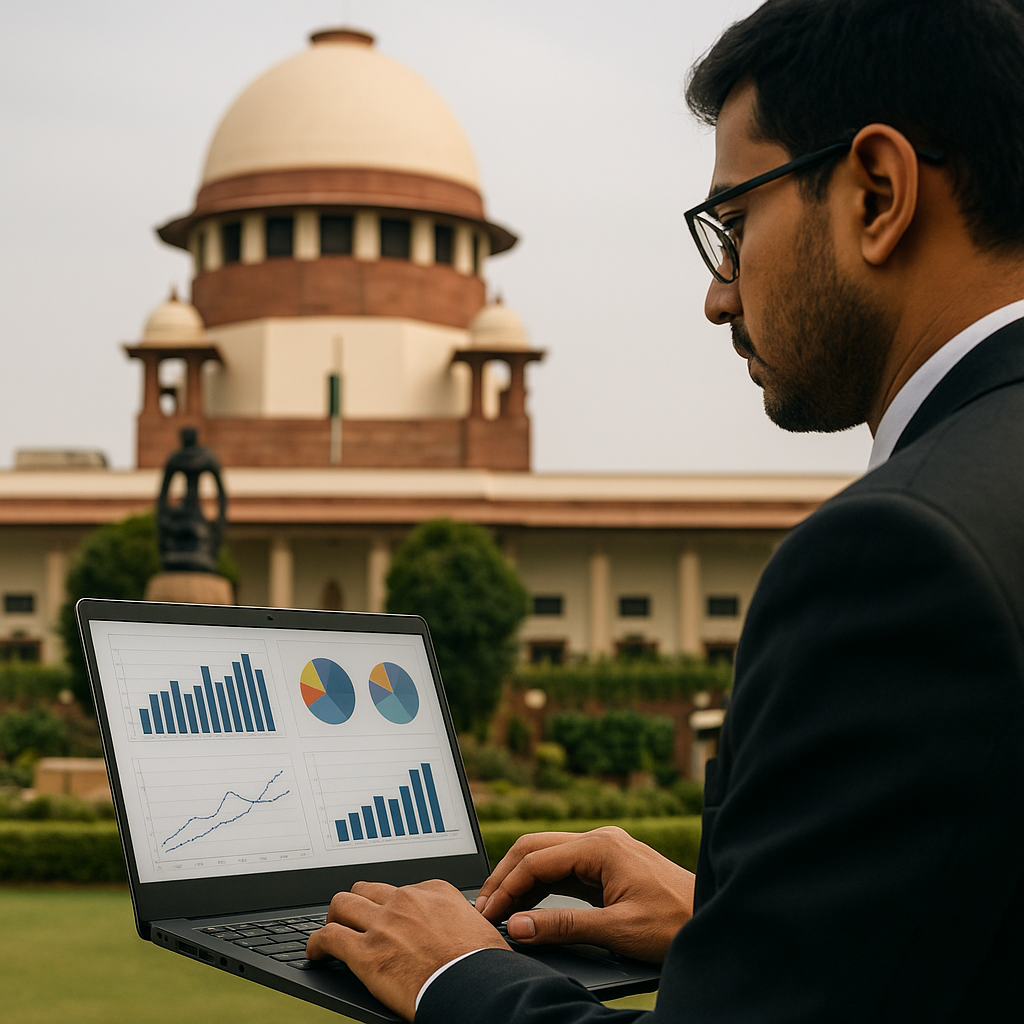
How Legal Analytics Is Changing Supreme Court Litigation Research in India
Picture this: a junior advocate in Delhi, drowning in files, manually flipping through old Supreme Court judgments for that one precedent that might swing a case. Or a senior partner, frustrated because the research team missed a key trend in how a particular bench interprets a statute. If you’ve ever worked on Supreme Court litigation in India, you know the pain. The sheer volume of data, the pace of judgments, and the unpredictability of benches have always made legal research a challenge. Now, legal analytics is quietly transforming how lawyers, researchers, and even judges approach Supreme Court litigation research in India.
Why does this matter? The stakes are massive. One overlooked precedent can shift a billion-rupee dispute. With the Supreme Court hearing thousands of matters each year, missing a trend or a key citation is easier than you think. So, understanding how legal analytics is changing Supreme Court litigation research in India isn’t just for techies or academics – it’s essential for anyone who wants to win, or even survive, in the country’s highest court.
Legal analytics is changing Supreme Court litigation research in India by making it faster, more accurate, and data-driven – helping lawyers spot patterns, predict outcomes, and build stronger arguments with evidence-backed insights.
How Tech-Driven Analytics Is Shaping Supreme Court Legal Research
What Is Legal Analytics in the Supreme Court Context?
Legal analytics means using technology to turn massive, unstructured legal data into practical insights. For the Supreme Court, this covers everything from judgment databases to bench compositions, citation networks, and case timelines.
At its core, legal analytics combines elements of:
– Artificial intelligence (AI): Machine learning models that read, classify, and summarise judgments.
– Natural language processing (NLP): Extracting legal concepts, statutes, and case outcomes from judgments written in complex legal English.
– Data visualisation: Turning raw data into charts, heatmaps, and dashboards for quick understanding.
For Supreme Court litigation research in India, this means:
– Quickly finding relevant precedents, not just by keyword but by legal principle, outcome, or even the judge’s approach.
– Analysing how certain benches or judges have ruled on similar questions of law over time.
– Predicting possible outcomes based on historical data.
How Is Legal Analytics Different from Traditional Research?
Traditional research meant:
– Reading headnotes in AIR or SCC volumes.
– Relying on manual keyword searches.
– Depending on senior lawyers’ memory or anecdotal experience.
Legal analytics, on the other hand, offers:
– Instant access to millions of data points.
– Pattern recognition (e.g., how often a particular Article of the Constitution is invoked).
– Cross-linking of cases, statutes, and arguments.
The result? Less guesswork, more evidence.
Key Tools and Platforms Used in India
Several platforms have started offering legal analytics for Supreme Court research in India, including:
– SCC Online: Offers citation analysis, judge profiles, and precedent networks.
– Manupatra: Provides data visualisation of case histories and citation graphs.
– Supreme Court Vidhik Anuvaad Software (SUVAS): Uses AI for translation and case document analytics.
– Indian Kanoon: Open-access search with some analytics features.
Each has its own strengths. Honestly, most lawyers still use a mix, depending on the case and budget.
Why Legal Analytics Matters for Supreme Court Litigation
Legal analytics isn’t just a fancy dashboard. It changes the very nature of how cases are prepared, argued, and decided in the Supreme Court.
Legal analytics matters because it gives litigators and judges the power to make decisions based on comprehensive data, not just instinct or limited experience.
Impact on Lawyers and Law Firms
For advocates and law firms, the advantages are clear:
– Speed: Research that took days now takes minutes.
– Depth: Find not just the obvious precedents, but subtle trends and outlier judgments.
– Customisation: Filter by judge, year, subject, or even the outcome.
A young associate told me she once found a game-changing precedent buried three levels deep in a citation chain, thanks to analytics. Before, she’d have missed it.
Influence on Courtroom Strategy
Legal analytics helps lawyers:
– Anticipate how a particular bench might react to an argument.
– Prepare counter-arguments based on how opposing counsel has fared in similar matters.
– Avoid relying on overruled or weak precedents.
For example, if data shows Justice X has consistently interpreted a tax statute narrowly, you might rethink a broad interpretation argument before that bench.
Benefits for Judges and Judicial Clerks
Judges and their clerks use analytics to:
– Check the most-cited precedents on a legal question.
– Identify conflicting judgments that need to be resolved by a larger bench.
– Ensure consistency in reasoning across cases.
Some judges are still old-school, but a growing number are asking their clerks for analytics reports before hearings.
Transparency and Accountability
Legal analytics also:
– Makes judicial trends visible to the public.
– Helps watchdogs and journalists spot patterns in bail, death penalty, or PIL matters.
– Supports academic research into judicial behaviour.
How Legal Analytics Works: The Nuts and Bolts
Legal analytics is not just about fancy graphs. There’s a method to the magic.
Legal analytics in Supreme Court research works by collecting, cleaning, and analysing large volumes of legal texts using AI and data science, then presenting actionable insights through user-friendly interfaces.
Data Collection and Structuring
The process usually starts with:
– Scraping or importing text from Supreme Court judgments, orders, and cause lists.
– Structuring unformatted text into fields like case number, parties, statutes cited, bench composition, and outcome.
Most Indian analytics tools rely on public domain data, but some premium services have proprietary datasets with more granular tagging.
Natural Language Processing (NLP) for Legal Texts
Legal English in Supreme Court judgments is dense and nuanced. NLP tools are trained to:
– Recognise legal terms, statutes, and citations.
– Extract relationships (e.g., which judgments overrule or follow others).
– Summarise long passages into key holdings.
Some platforms even offer clause-by-clause breakdowns of long constitutional judgments.
Machine Learning and Pattern Recognition
Over time, machine learning models:
– Identify trends (e.g., increase in privacy-related cases post-Puttaswamy).
– Score precedents for relevance, authority, and treatment by subsequent benches.
– Predict possible outcomes based on features like bench composition and legal issue.
It’s not always perfect. Sometimes the AI gets confused by ambiguous language. But accuracy improves as more data is fed in.
Data Visualisation and User Dashboards
The final step is making all this digestible:
– Interactive timelines of case progress.
– Heatmaps showing which statutes are invoked most often.
– Judge profiles with statistics on reversal rates and dissenting opinions.
Most platforms let users export charts or download reports for sharing in court or with clients.
Integration with Practice Management
Some law firms now integrate analytics dashboards with their case management software, so lawyers can:
– Track how their own cases fit into broader legal trends.
– Benchmark their success rates against industry averages.
– Automate alerts for new judgments on relevant topics.
Real-World Examples: How Legal Analytics Is Used in Supreme Court Litigation Research in India
Seeing legal analytics in action makes its value obvious. Here are a few concrete scenarios from recent years.
Legal analytics is used in Supreme Court litigation research in India to identify winning arguments, track judge-specific trends, and avoid pitfalls like citing overruled cases.
Example 1: Predicting Bench Outcomes
In a high-stakes arbitration matter, a Mumbai law firm used analytics to:
– Analyse how the current Supreme Court bench had ruled on similar arbitration clauses.
– Spot that one judge had consistently favoured party autonomy, while another was stricter about statutory limits.
– Tailor their arguments to focus on the autonomy aspect, which ultimately helped them win a favourable order.
Example 2: Spotting Overruled Precedents
A Delhi senior counsel avoided embarrassment by using analytics to check a citation chain. The tool flagged that a 1989 judgment, often cited in textbooks, had actually been overruled in 2012. Without the tool, the error might have gone unnoticed until opposing counsel pointed it out.
Example 3: Tracking Trends in PIL Matters
An NGO wanted to file a PIL on environmental regulation. Using analytics, they:
– Mapped how the Supreme Court’s approach to environmental PILs had evolved since the 1990s.
– Noted an uptick in dismissals on maintainability grounds post-2017.
– Reframed their petition’s prayers to address these maintainability concerns upfront.
Example 4: Academic and Policy Research
Researchers at a leading law school used analytics to:
– Quantify how often Article 21 (Right to Life and Personal Liberty) was invoked in the last decade.
– Compare how different benches interpreted privacy rights before and after the landmark Puttaswamy judgment.
Other Practical Uses
- Law firms benchmarking their win rates against competitors.
- Journalists tracking how often certain senior advocates appear before the Supreme Court.
- Policy think tanks analysing delays in constitutional bench references.
Common Mistakes and Misconceptions in Legal Analytics Adoption
It’s tempting to think analytics will do all your research for you. That’s not how it works, honestly.
Common mistakes in adopting legal analytics for Supreme Court research include over-reliance on automation, misunderstanding of data limitations, and ignoring the context behind numbers.
Mistake 1: Blind Trust in the Numbers
Some users assume:
– All data is accurate and up-to-date.
– An AI-generated case summary captures every nuance of a judgment.
– If the dashboard says a precedent is “leading,” it must be safe to cite.
But legal language is subtle. Sometimes, machine summaries miss a crucial caveat or exception buried in the text.
Mistake 2: Ignoring Data Gaps and Biases
Indian legal data isn’t perfect. Issues include:
– Missing metadata (e.g., incomplete party names or bench details).
– Errors in scanned PDF judgments.
– Gaps in data for older cases or sealed matters.
Always double-check against the official Supreme Court website or physical records before relying on analytics outputs.
Mistake 3: Misinterpreting Trends
Just because a judge has ruled a certain way in the past doesn’t guarantee they’ll repeat it. Legal context, facts, and even public sentiment can shift outcomes. Analytics suggest probabilities, not certainties.
Mistake 4: Overlooking Qualitative Insights
Analytics can show you the numbers, but:
– Reading the full judgment is still essential for understanding ratio decidendi (the court’s reasoning).
– Nuances like tone, judicial philosophy, or policy considerations can’t always be quantified.
How to Avoid These Pitfalls
- Use analytics as a starting point, not the final word.
- Always corroborate with traditional research and human judgment.
- Get basic training on how to interpret analytics dashboards.
Best Practices for Using Legal Analytics in Supreme Court Research
To get the most out of legal analytics, a thoughtful approach is needed.
Best practices for using legal analytics in Supreme Court litigation research in India include combining data-driven insights with traditional research, validating sources, and tailoring analysis to the specific case context.
Step-by-Step Approach
- Define Your Research Question
– Be specific. Are you looking for all judgments on a particular section, or only those decided by a specific bench? - Select the Right Tool
– Compare features, coverage, and pricing across platforms like SCC Online, Manupatra, and Indian Kanoon. - Start with Macro Trends
– Use analytics to scan the big picture: which years or judges saw spikes in your issue? - Drill Down to Precedents
– Identify the most-cited, most-followed, and most-distinguished cases relevant to your issue. - Check for Conflicting Judgments
– Use citation maps or treatment history tools to spot splits or overrulings. - Read the Full Text
– Never rely only on summaries or headnotes. Read the full judgment, especially for key precedents. - Validate and Cross-Check
– Confirm analytics findings against the Supreme Court’s official database or physical reporters. - Document Your Process
– Save your analytics queries and exports for reference, especially in complex or long-running matters.
Tips for Effective Use
- Regularly update your analytics tool to access the latest judgments.
- Collaborate with teammates – sometimes a fresh pair of eyes catches a missed trend.
- Attend webinars or workshops. Most platforms offer free training sessions.
Integrating Analytics Into Firm Culture
Firms that get the most value from analytics:
– Encourage sharing of analytics insights across teams.
– Assign a dedicated research lead to handle complex queries.
– Build custom dashboards for recurring clients or practice areas (e.g., tax, arbitration, constitutional law).
Trends, Challenges, and the Future of Legal Analytics in Supreme Court Research
Legal analytics in India is still evolving. The next few years will see both big leaps and some tough hurdles.
The future of legal analytics in Supreme Court litigation research in India will be shaped by advances in AI, open data initiatives, and growing demand for transparency and efficiency.
Recent Developments
- The Supreme Court’s eCourts project is releasing more data in machine-readable formats.
- Startups like Casemine and Legitquest are experimenting with deep learning for argument analysis.
- Some law firms are hiring data scientists to build custom analytics tools.
Ongoing Challenges
- Data Quality: Scanned PDFs, missing metadata, and inconsistent formatting make data cleaning tough.
- Language Barriers: Judgments in Hindi or regional languages are not always translated.
- Bias and Fairness: Algorithms can reflect biases present in historical judgments.
- Access and Cost: Premium analytics tools can be expensive for solo practitioners or small firms.
What’s Next?
- AI-Driven Argument Generation: Tools that suggest draft arguments based on past winning submissions.
- Real-Time Analytics: Dashboards that update as new judgments are uploaded daily.
- Wider Adoption: As more young lawyers and judges grow up with tech, analytics will become standard practice.
- Policy Impact: Analytics data could influence judicial appointments, bench assignments, and even legal education curricula.
Honest Outlook
Legal analytics won’t replace lawyers or judges. But it will keep raising the bar for what counts as thorough research and sound argumentation in the Supreme Court.
Frequently Asked Questions
What is legal analytics in Supreme Court litigation research in India?
Legal analytics in Supreme Court litigation research refers to the use of technology, AI, and data science to analyse large volumes of Supreme Court judgments, orders, and legal texts. It helps lawyers and researchers identify trends, key precedents, and judge-specific patterns to make research faster, more accurate, and data-driven.
How does legal analytics improve legal research for Supreme Court cases?
Legal analytics improves Supreme Court research by automating the process of finding relevant judgments, tracking bench trends, and highlighting overruled or distinguished precedents. It also provides visual summaries and statistical insights, reducing manual effort and the risk of missing critical information.
Which are the leading legal analytics platforms for Supreme Court research in India?
The most popular legal analytics platforms for Supreme Court research in India include SCC Online, Manupatra, Casemine, Legitquest, and Indian Kanoon. Each offers unique features like citation maps, judge profiles, and advanced search, with varying coverage and price points.
Can legal analytics predict the outcome of a Supreme Court case?
Legal analytics can suggest likely outcomes based on historical patterns, bench composition, and legal issues. However, it cannot guarantee results, as each case depends on unique facts, arguments, and judicial discretion. Use analytics as a guide, not a crystal ball.
What are common mistakes when using legal analytics for Supreme Court research?
Common mistakes include over-reliance on automated summaries, ignoring data gaps or errors, misinterpreting trends, and skipping a full reading of judgments. Always corroborate analytics findings with traditional research and official sources.
How do legal analytics platforms handle language diversity in Supreme Court judgments?
Most analytics platforms currently focus on English judgments. Some, like SUVAS, are working on AI-powered translation for Hindi and regional languages, but coverage is still limited. Always check if a judgment is available in your preferred language.
Is legal analytics affordable for small law firms or solo practitioners?
Many legal analytics tools offer tiered pricing, with basic plans starting around ₹2,000 – ₹5,000 per month. Indian Kanoon offers some free search and analytics features, but advanced tools can be expensive for smaller practices.
How do legal analytics tools ensure data accuracy?
Leading platforms regularly update their databases from official Supreme Court sources and use manual checks and automated validation to reduce errors. However, users should always verify key findings against original judgments and the Supreme Court website.
What skills are needed to use legal analytics effectively?
Effective use requires basic legal research skills, familiarity with analytics dashboards, and the ability to interpret data and trends. Most platforms offer training sessions and webinars for new users.
Can legal analytics identify conflicting or overruled Supreme Court judgments?
Yes. Many analytics tools highlight treatment history, showing if a judgment has been followed, distinguished, or overruled in later cases. Users can trace citation chains to avoid relying on outdated or overturned precedents.
How is legal analytics integrated into law firm workflows?
Firms integrate analytics by linking tools with case management systems, training research teams, and building custom dashboards for frequent practice areas. This streamlines research and supports data-driven strategy.
Are there privacy or ethical concerns with legal analytics in Supreme Court research?
Most analytics tools use public domain data, but concerns exist about algorithmic bias, data privacy (for sensitive matters), and over-reliance on predictive tools. Responsible use and transparency are recommended.
How do legal analytics help in public interest litigation (PIL) matters?
Analytics tools help NGOs and advocates track trends in PIL outcomes, identify successful arguments, and anticipate likely judicial approaches, improving the chances of filing effective petitions.
What is the future of legal analytics in Supreme Court litigation research in India?
Legal analytics will become more advanced with AI-driven argument generation, real-time updates, better language support, and wider adoption among lawyers and judges. However, human judgment and traditional research will remain essential.
How can I get started with legal analytics for Supreme Court research?
Start by identifying your research needs, choosing a suitable analytics platform, and attending training sessions or webinars. Combine analytics findings with traditional research for best results.
Key Takeaways
- Legal analytics uses AI, NLP, and data science to make Supreme Court research faster and more accurate.
- Popular Indian platforms include SCC Online, Manupatra, Casemine, and Indian Kanoon.
- Analytics helps spot trends, judge-specific patterns, and overruled precedents.
- Always corroborate analytics findings with full-text judgments and official sources.
- Common mistakes include over-reliance on automation and misunderstanding data gaps.
- Best practice is to blend analytics with traditional legal research skills.
- Analytics is shaping courtroom strategies and even influencing judicial decision-making.
- Data quality, language barriers, and cost remain challenges for wider adoption.
- The future will see more advanced AI features and greater integration into law firm workflows.
- Human expertise and critical reading are still essential for Supreme Court litigation research.
Legal analytics isn’t just a buzzword anymore. For Supreme Court litigation research in India, it’s fast becoming the difference between average and outstanding legal work. The best lawyers and researchers use analytics to find hidden patterns, avoid costly mistakes, and prepare arguments that stand up in the country’s highest court.
But the tools alone aren’t enough. Success comes from combining analytics with deep reading, sound judgment, and an honest respect for the complexity of Indian law. If you’re serious about Supreme Court work, embracing analytics is no longer optional – it’s simply the new normal.
